

The Engineering Behind Premium Assembly Gloves
We do not just sew leather together. We engineer safety solutions. When we design premium assembly gloves, we start with the specific mechanical risks found in modern assembly lines. The market is flooded with generic gloves that claim to be safe but fail when tested against rigorous European standards. At Ocean Gloves Corporation, we take a different approach. We build our CE certified assembly gloves from the molecular level up, focusing on the interaction between the leather fibers and the user’s hand. This is not about fashion. It is about consistent mechanical protection and documented compliance.
Material Science: Why Premium Leather Assembly Gloves Matter
The foundation of any high-performance glove is the raw material. For our premium leather assembly gloves, we select specific hides based on their fiber density and tensile strength. We often use goatskin for its high lanolin content which provides natural water resistance and softness, or cowhide for superior abrasion resistance.
A common issue with lower-grade certified assembly gloves is the inconsistency in leather thickness. If the leather is too thin, it fails the abrasion test. If it is too thick, you lose the dexterity required for precision manufacturing gloves. We maintain a strict thickness tolerance of +/- 0.1mm. This precision ensures that when we produce professional grade CE certified assembly gloves wholesale, every single pair performs identically to the sample you approved.
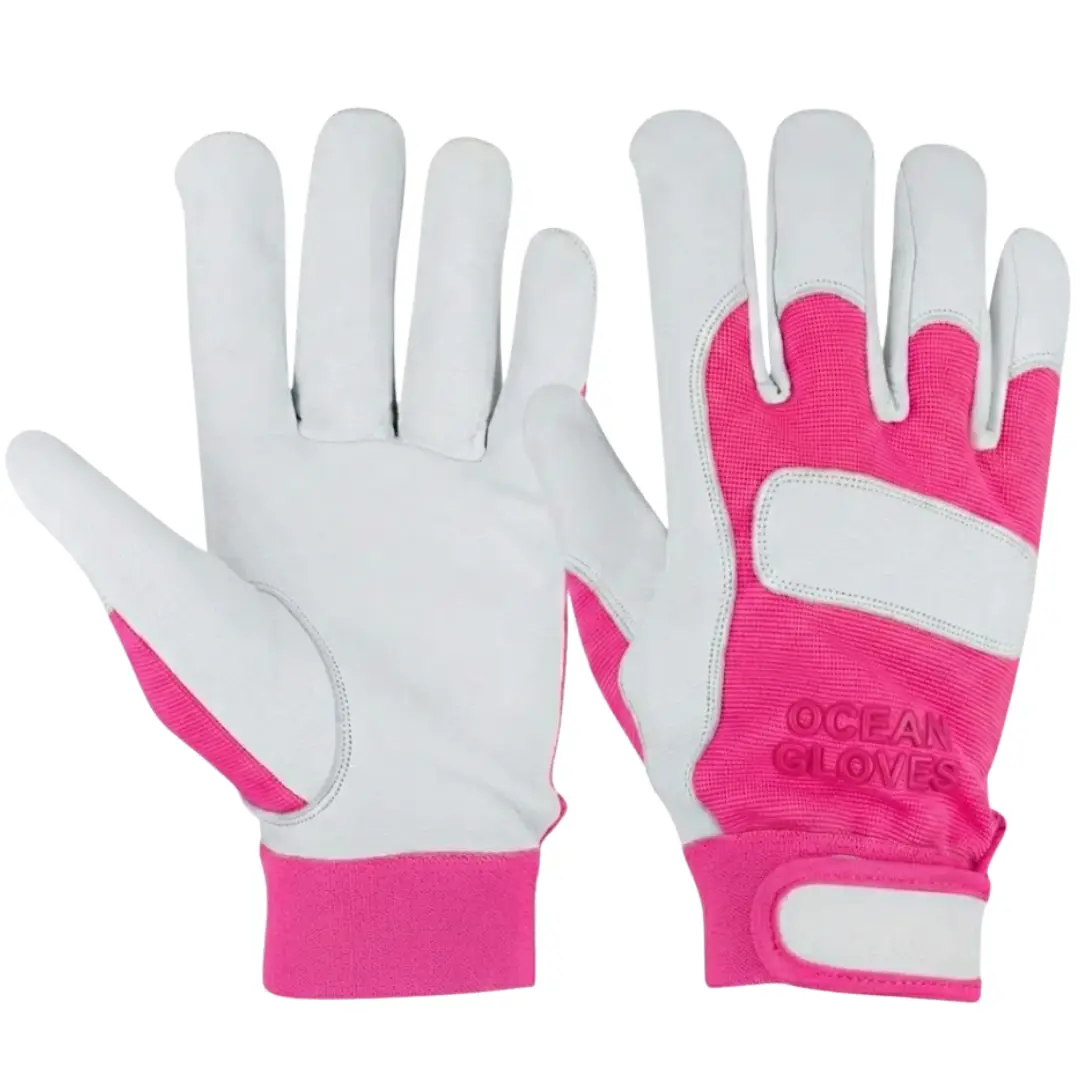
The back of the hand features a four-way stretch fabric. This is not standard polyester. We use a technical blend that allows for expansion in both vertical and horizontal directions. This is critical for preventing hand fatigue. When a worker closes their hand to grip a tool, the back of the glove must expand. If the material resists this movement, the worker’s muscles have to fight the glove all day. Our design eliminates this resistance.
The Physics of the Velcro Assembly Gloves Closure
Many manufacturers treat the closure system as an afterthought. We view it as a primary safety feature. Our adjustable wrist assembly gloves utilize a specific grade of hook-and-loop fastener that resists clogging from dust and lint.
The positioning of the Velcro strip is calculated to sit exactly on the wrist pulse point. This secures the glove without cutting off circulation. A loose glove is a safety hazard because it can get caught in machinery. A glove that is too tight causes numbness. Our premium assembly gloves with adjustable velcro wrist allow the operator to dial in the exact tension needed for their specific hand size. This customization is essential for quality control certified gloves used in sensitive environments.
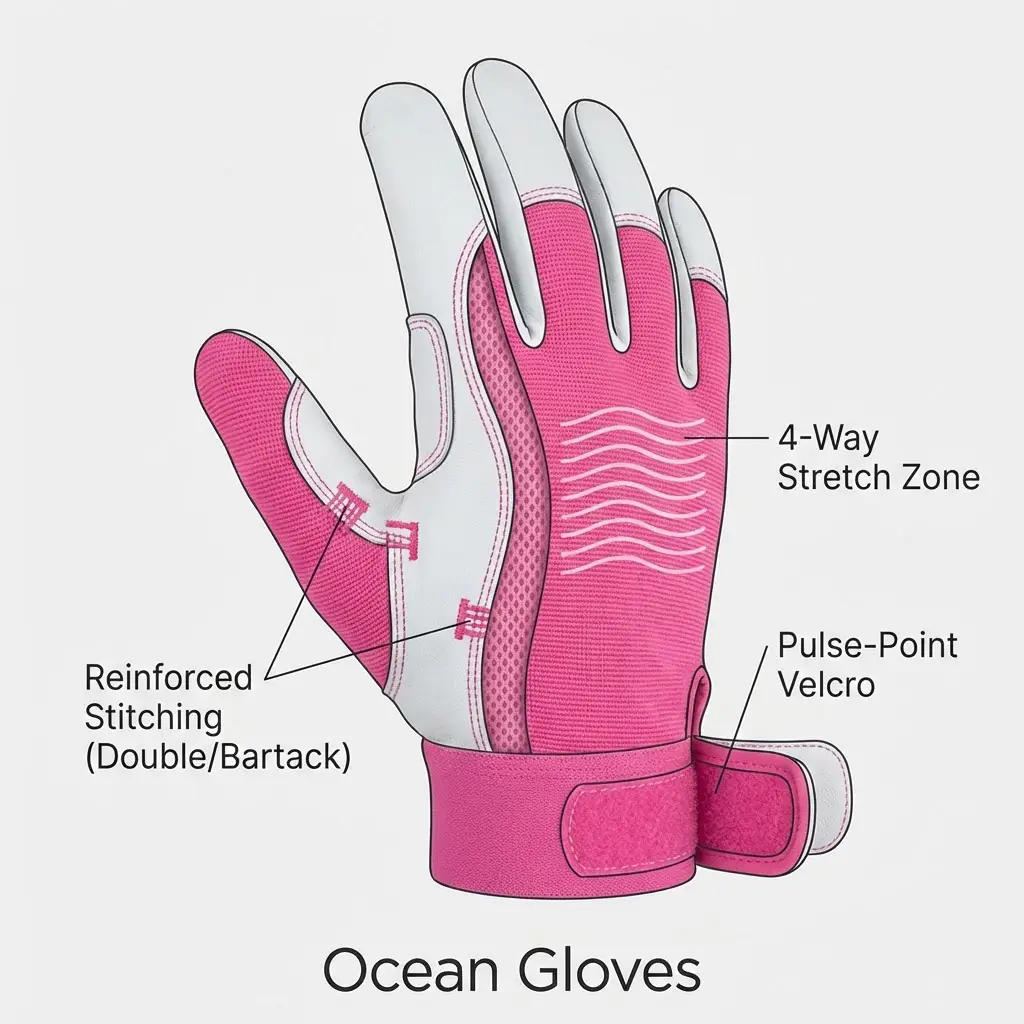
Visual breakdown of the glove layers, highlighting the reinforced stitching, the pulse-point Velcro placement, and the 4-way stretch zones.
The “Raw to Box” Manufacturing Process
We operate as a fully integrated premium assembly gloves manufacturer Sialkot. This means we do not buy finished leather from open markets. We buy raw hides and process them ourselves.
Tanning and pH Control: We tan the leather to ensure it is free from Chrome VI and meets all REACH regulations. We monitor the pH levels to ensure they remain neutral (between 3.5 and 9.5), which prevents skin irritation during long shifts.
Die Cutting: We use hydraulic press cutters with forged steel dies. This ensures that the CE marked premium assembly gloves with velcro closure you order have identical sizing batch after batch. Hand cutting introduces too much variance for certified PPE.
Stitching and Assembly: We use high-tensile nylon or Kevlar thread depending on the spec. The stitching density is set to 4-5 stitches per centimeter. This prevents seam bursting under stress, a common failure point in cheap European standard assembly gloves.
Final Audit: Every glove passes through a metal detector and a visual inspection station before packaging.
Certification Physics: Decoding EN-388:2016 Gloves
Understanding certification is vital for any buyer importing European standard EN-420 assembly gloves Sialkot. The EN388 rating is not just a sticker. It represents physical testing data.
Abrasion Resistance (First Number): We test the leather against sandpaper under a specific pressure. Our leather survives over 500 cycles to achieve Level 2 or higher.
Blade Cut Resistance (Second Number): This measures how many cycles a circular blade takes to cut through.
Tear Resistance (Third Number): This is crucial for assembly work. We ensure the leather structure holds together when snagged.
Puncture Resistance (Fourth Number): We test the force required to push a standard needle through the material.
We provide complete documentation for our EN388 certified assembly gloves manufacturer Pakistan operations. This includes the Declaration of Conformity and the official test reports from accredited labs like CTC or SATRA.
Technical DNA: Specification Comparison
The following table outlines the technical specifications that define our quality certified gloves.
| Specification | Ocean Gloves Standard | Generic Market Standard | Engineering Impact |
| Leather Grade | Grade A (Selected Hides) | Grade C or Split | Higher tensile strength and durability. |
| Thickness Tolerance | +/- 0.1mm | +/- 0.3mm | Consistent dexterity for fine assembly. |
| Stitching Density | 4-5 SPI (Stitches Per Inch) | 2-3 SPI | Prevents seam failure during heavy use. |
| pH Level | 3.5 – 9.5 (Skin Neutral) | Uncontrolled | Prevents dermatitis and skin reactions. |
| Fabric Memory | 95% Recovery | 60% Recovery | Glove retains shape after stretching. |
| Chrome VI | < 3 mg/kg (Undetectable) | Often Present | Compliance with EU REACH regulations. |
Solving Compliance for a German Automotive Supplier
A distributor in Germany approached us with a crisis. Their previous supplier sent a container of EN-420 assembly gloves that failed random customs testing for Chromium VI content. The entire shipment was destroyed, and they faced severe fines.
They needed a certified work gloves exporter Pakistan who could guarantee chemical compliance. Ocean audited their requirements and transitioned them to our premium assembly gloves line. We implemented a batch-testing protocol where we test the leather for Chrome VI at the wet-blue stage and again at the crust stage.
We also redesigned the wrist closure to create premium assembly gloves with adjustable velcro wrist tabs that were 5mm wider, improving the grip for workers wearing heavy watches. The result was a 100% pass rate on all subsequent shipments and a 15% reduction in glove replacement costs due to the improved durability of our leather. This proves that buying professional assembly gloves is an investment in reliability.
Logistics and Documentation
We are an experienced EN388 gloves supplier Pakistan. We understand that the paperwork is as important as the product. For every shipment of CE marked assembly gloves, we provide the technical file, the user information sheet in the required languages, and the lab test reports. We pack our gloves to prevent moisture damage during ocean transit, ensuring they arrive at your warehouse in pristine condition.
Why Professional Assembly Work Demands Precision
In precision manufacturing gloves, tactile sensitivity is currency. If a worker cannot feel the small screw or the wire they are installing, they will remove the glove. A removed glove offers zero protection. We skive (thin) the leather at the fingertips to reduce bulk without compromising the abrasion rating. This attention to detail is what makes us a leader in European market assembly gloves. We verify the dexterity level according to EN 420 standards, ensuring the gloves can pick up the smallest diameter pins required by the test.
We invite you to audit our facility. See how we produce certified maintenance gloves that protect your workforce and your legal standing.
FAQs
1. Why is the pH level of the leather critical for European standard assembly gloves?
The pH level determines the acidity or alkalinity of the leather. If the pH is too low (acidic) or too high (alkaline), it reacts with the sweat on the worker’s hand. This causes skin irritation, dermatitis, and can even cause the leather to degrade and rot prematurely. We maintain a rigorous pH balance to ensure our EN-420 assembly gloves are hypoallergenic and durable.
2. How do you ensure the Velcro closure lasts as long as the leather?
We use industrial-grade micro-hook Velcro. Standard Velcro degrades after a few hundred cycles of opening and closing, especially in dusty environments where lint clogs the hooks. Our premium assembly gloves use a specialized fastener that sheds debris and maintains shear strength for thousands of cycles, ensuring the adjustable wrist assembly gloves remain secure throughout their lifespan.
3. What is the difference between EN 388:2003 and EN 388:2016 for these gloves?
The 2016 update introduced the TDM-100 cut test (ISO 13997) for more accurate cut resistance measuring and added an impact protection test. For our EN-388:2016 gloves, we provide ratings based on the current standard, specifically clarifying the abrasion and tear resistance which are most relevant for general assembly tasks.
4. Why do you use four-way stretch fabric instead of standard cotton?
Cotton jersey stretches in one direction or not at all. Human hands are dynamic; they expand when gripping. Four-way stretch fabric moves with the hand’s biomechanics. This reduces the energy required to close the hand, significantly lowering the risk of repetitive strain injuries (RSI) in professional assembly work.
5. Can these gloves be used for certified maintenance gloves applications?
Yes. While designed for assembly, the abrasion resistance of our premium leather assembly gloves makes them suitable for maintenance. However, for maintenance involving sharp metal edges or heavy oil, we might recommend our specific cut-resistant or oil-resistant lines.
6. How do you control Chrome VI levels in your certified work gloves exporter Pakistan operations?
Chrome VI is a byproduct of improper tanning oxidation. We use high-grade tanning agents and strictly control the drying temperature and humidity. We test every batch of leather before it enters the cutting room. This internal protocol guarantees that our exports meet EU REACH regulations.
7. Why is the CE mark mandatory for assembly gloves in the EU?
The CE mark is a declaration that the product meets the essential health and safety requirements of European Regulation (EU) 2016/425. Without this mark and the supporting technical file, the gloves cannot be legally sold or used in the EU. We provide valid CE marked assembly gloves with full traceability.
8. Do you manufacture the CE marked premium assembly gloves with velcro closure entirely in-house?
Yes. We are a premium assembly gloves manufacturer Sialkot with vertical integration. We do not outsource stitching or cutting to home workers. This centralization allows us to control the thread tension, seam allowance, and material quality, which is impossible to guarantee with outsourced labor.
9. How does leather thickness affect the EN388 rating?
Thickness correlates with abrasion and puncture resistance. However, adding thickness reduces dexterity. We engineer our CE certified assembly gloves by selecting hides with dense fiber structures. This allows us to achieve high abrasion ratings with thinner leather (0.7-0.8mm), maintaining the dexterity needed for precision work.
10. What defines “Professional Grade” in your professional assembly gloves?
Professional grade refers to the consistency of materials and construction. It means using full-grain leather rather than splits, nylon bonded thread rather than cotton, and reinforced stress points. It ensures that the glove lasts weeks or months, not days, which calculates to a lower cost-per-use for the buyer.
11. Why is the pulse-point placement of the Velcro important?
If the strap is too high, it restricts wrist mobility. If it is too low, the glove slips. Our premium assembly gloves with adjustable velcro wrist feature a strap positioned exactly over the carpal bones. This locks the glove in place without restricting the blood flow or the range of motion required for assembly tasks.
12. Can you produce European standard EN-420 assembly gloves Sialkot with custom logos?
Technically, yes. We use heat transfer or silk screen printing for logos. However, the ink used must also be tested to ensure it does not negatively interact with the leather or contain banned substances that would void the CE certification compliance.
13. What testing methods do you use for quality control certified gloves?
Ocean perform random lot sampling based on AQL 2.5 standards. We check for physical dimensions, visual defects, and mechanical strength. Ocean also perform “donning and doffing” tests to ensure the adjustable wrist assembly gloves are easy to put on and take off, which is a requirement for user compliance.
14. Why is goatskin often preferred for premium leather assembly gloves?
Goatskin has a higher tensile strength-to-weight ratio than cowhide due to its tight fibrous structure. It also contains natural lanolin, which keeps the leather soft without artificial softeners that can leach out over time. This makes it ideal for precision manufacturing gloves.
15. How does the EN388 certified assembly gloves manufacturer Pakistan verification process work?
You verify us by checking our Module B (Type Examination) and Module C2 or D (Quality Assurance) certificates issued by a Notified Body (like SATRA or CTC). We provide these certificates upfront so you can validate them directly with the testing body.
16. What is the impact of humidity on these gloves during storage?
Leather is hygroscopic. High humidity can cause mold; low humidity can cause brittleness. We pack our quality certified gloves with moisture-absorbing silica gels and use polybags that regulate air exchange. Proper storage in your warehouse is also critical to maintain the EN 388 performance levels.
17. Do these gloves meet ANSI standards as well as EN standards?
While our primary focus for this line is European standard assembly gloves (EN), the physical properties often correlate with ANSI/ISEA 105 standards. We can provide ANSI test data for abrasion and cut resistance upon request for the North American market.
18. Why is dexterity a safety feature in professional grade CE certified assembly gloves wholesale?
Lack of dexterity causes workers to drop tools or parts, creating hazards. It also leads to workers removing gloves to perform fine tasks, exposing them to injury. We prioritize dexterity (EN 420 Level 5) to ensure the gloves stay on the hands during the entire shift.
19. How do you prevent seam rupture in the four-way stretch fabric?
Fabric and leather have different stretch properties. If stitched incorrectly, the needle holes in the fabric elongate and tear. We use a ball-point needle and a specific thread tension that allows the seam to stretch with the fabric, ensuring the structural integrity of our CE certified assembly gloves.
20. What makes your adjustable wrist assembly gloves superior to elastic cuffs?
Elastic cuffs lose elasticity over time and cannot adjust to different wrist sizes. A worker with a thin wrist might have gaps where debris enters. Our Velcro closure system allows for a personalized fit every time, maintaining a seal against dust and particles, which is vital for quality control certified gloves.
WhatsApp us or email Sales@oceangloves.com
Facebook | Twitter | Instagram | YouTube | LinkedIn