




The Engineering Behind Sheepskin Assembly Gloves
We approach the manufacturing of Sheepskin Assembly Gloves differently than general purpose PPE. When we design a glove for precision assembly, the primary engineering constraint is the balance between protection and proprioception. Proprioception is the ability of the wearer to sense the position and movement of their fingers. Heavy leather kills this sensation. Our sheep leather assembly gloves are engineered to preserve it. This section details exactly how we transform raw pelts into the most sensitive industrial gloves on the market.
Sourcing Premium Sheepskin Leather for precision tasks
The journey of our sheepskin work gloves begins with the selection of the raw material. Not all sheepskins are suitable for industrial use. We specifically source hides that have a tighter fiber weave. Sheepskin naturally has a higher fat content and looser fiber structure compared to cowhide. This is what makes it soft, but it can also make it weak if not selected correctly.
We select skins that have been processed to retain the grain strength while maximizing flexibility. We look for a thickness range of 0.6mm to 0.8mm. Anything thicker than 0.8mm reduces the tactile sensitivity required for electronics handling gloves. Anything thinner than 0.6mm risks tearing during the stitching process. As a sheep leather gloves manufacturer Sialkot, we have first pick of the local tanneries, allowing us to reject skins that show scar tissue or uneven grain which would compromise the integrity of the glove.
The physics of soft sheepskin gloves in assembly lines
Why do we use sheepskin for delicate product assembly? It comes down to the modulus of elasticity. Sheep skin leather gloves have a lower modulus than goat or cow leather. This means it takes less force to bend the material. When a worker closes their hand 2,000 times a shift on an assembly line, the resistance of the glove material adds up to significant muscle fatigue.
By using soft sheep leather gloves, we drastically reduce the energy required to make a fist. This reduction in resistance translates directly to higher productivity and fewer repetitive strain injuries. The lanolin naturally present in sheepskin also keeps the leather supple over time, preventing the “crusting” effect often seen in cheaper leathers after they have been exposed to sweat and then dried out.
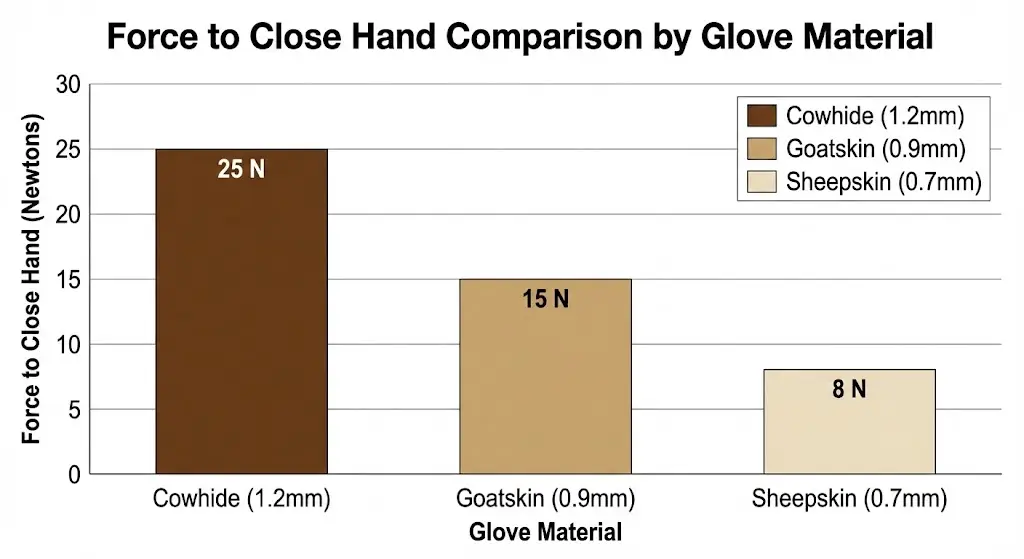
Comparing the ‘Force to Close Hand’ (Newtons) between Cowhide (1.2mm), Goatskin (0.9mm), and Sheepskin (0.7mm). Sheepskin.
Manufacturing ultra-soft assembly gloves
The construction of ultra-soft assembly gloves requires specialized machinery. We cannot use the same heavy-duty sewing machines used for rigger gloves. The needle gauge must be finer, and the thread tension must be lower. If the tension is too high, the thread will cut through the soft sheep leather.
We utilize a wing thumb design in our premium sheepskin assembly gloves. This removes the seam from the palm area, which is the primary wear point. For the back of the hand, we integrate Trinda fabric. We choose Trinda over standard cotton because it has a slight sheen and better resistance to pilling. This combination creates lightweight assembly gloves that breathe. The fabric back allows heat to escape, keeping the hand dry. Moisture is the enemy of leather longevity, so this breathability extends the life of the glove.
Quality control for premium sheep leather gloves
We act as a primary sheepskin work gloves supplier Pakistan for several major European brands. They rely on us because our sorting process is rigorous. After the leather is dyed and dried, we perform a “flex and pull” test on every batch. We measure the elongation at break. Sheep leather has high tensile strength relative to its weight, but it must be cut in the correct direction relative to the spine of the animal to maximize this strength.
Our cutters are trained to read the grain. They place the die cutters so that the stress on the glove aligns with the strongest direction of the leather fibers. This is a detail that automated cutting systems often miss, but it is standard procedure for us as a soft leather gloves exporter Pakistan.
Technical DNA: Sheepskin vs. Competitor Leathers
The following table outlines the specific physical characteristics of our sheepskin compared to other common materials we process.
| Specification | Ocean Gloves Sheepskin | Standard Goatskin | Standard Cowhide | Benefit for Buyer |
| Thickness | 0.6mm – 0.8mm | 0.8mm – 1.0mm | 1.0mm – 1.2mm | Maximum Sensitivity |
| Flexibility | Extremely High | High | Medium | Reduced Hand Fatigue |
| Surface Texture | Smooth / Silky | Pebbled / Grainy | Rough / Fibrous | Better for fine parts |
| Tensile Strength | Medium | High | Very High | Adequate for light duty |
| Breathability | High (Porous) | Medium | Low | Comfort in hot plants |
| Primary Use | Precision / Electronics | General Assembly | Heavy Construction | Specificity of task |
Flexible sheep leather assembly gloves in application
We see the highest demand for these gloves in sectors requiring fine motor skills. For example, automotive detailing gloves needs to be soft enough not to scratch paint but durable enough to protect the detailer’s hands from compounds. Woodworking finishing gloves must allow the carpenter to feel the grain of the wood to check for smoothness.
In laboratory settings, laboratory work gloves made from sheepskin provide a barrier that does not impede the handling of test tubes or small instruments. The material provides a better grip on glass than synthetic nitrile in many cases, especially when the glass is slightly oily. The natural grain of the sheepskin creates friction without being abrasive.
Case Study: Solving a Tactile Issue for an Electronics Client
A client assembling drone components approached us. They were using synthetic PU coated gloves. Their workers were complaining that they could not feel the “click” when a small ribbon cable was properly seated. This led to them pushing too hard and damaging the connectors.
We proposed our ultra-soft sheepskin leather assembly gloves for precision work. We sent them samples of our Product #9. The feedback was immediate. The leather transferred the tactile feedback of the “click” through to the worker’s fingertips. The damage rate to the connectors dropped by 40 percent in the first month. Furthermore, the workers reported less sweating compared to the dip-coated synthetic gloves. This proves that for high-value manufacturing, natural materials like premium sheepskin leather often outperform modern synthetics.
The “Raw to Box” Manufacturing Process
Selection: We inspect raw skins at the tannery, rejecting any with open pores or insect bites.
Tanning: We use a chrome tanning process that softens the fibers specifically for comfortable sheepskin gloves.
Die Cutting: Skilled technicians cut the palm and fingers, avoiding the belly area of the hide where the leather is too stretchy.
Stitching: We use polyester thread for rot resistance. The fabric back is stitched to the leather palm using an inseam method for a clean look.
Ironing: A crucial step for sheepskin. We iron the gloves at a controlled temperature to smooth the grain and set the shape.
Inspection: Every pair is checked for loose threads and leather consistency before packing.
As a comfortable sheepskin assembly gloves manufacturer Pakistan, we invite you to audit this process. We do not hide our methods because they are the reason our gloves perform.
FAQs:
Q1: Why do you recommend ultra-soft sheepskin leather assembly gloves for precision work over goatskin?
Sheepskin has a finer grain structure and is naturally thinner than goatskin while remaining intact. For precision work, this difference of 0.2mm in thickness significantly impacts the worker’s ability to manipulate small screws or wires. Goatskin is durable, but sheepskin is sensitive.
Q2: As a premium sheep leather assembly gloves manufacturer Pakistan, how do you control leather thickness?
We use automated shaving machines at the wet blue stage of tanning. However, the final control is manual. We measure the hides with calipers before they enter the cutting room. We segregate hides into 0.6mm and 0.8mm piles to ensure that a single pair of gloves does not have uneven thickness.
Q3: Can these comfortable sheepskin assembly gloves for extended wear handle oily parts?
Sheepskin is naturally porous, which allows it to absorb small amounts of oil without becoming instantly slippery. However, for heavy oil saturation, the leather will eventually soak through. For light machine oil handling in assembly, they provide excellent grip and comfort.
Q4: What makes you a reliable soft sheep skin leather work gloves wholesale partner?
Reliability in sheepskin comes from grading. A wholesale partner must trust that we do not mix “Grade C” belly leather into the order to lower costs. We maintain strict segregation of leather grades. You get exactly the grade you pay for, which is critical for your resale reputation.
Q5: Are your lightweight sheepskin assembly gloves Sialkot produced environmentally?
Yes. Our tanning partners in Sialkot operate under strict environmental protection agency guidelines regarding water treatment. We ensure that the chrome used in tanning is properly neutralized and that wastewater is treated before discharge.
Q6: Why are these classified as precision assembly sheepskin gloves?
The classification comes from the pattern and the material. We use a “gunn cut” or “wing thumb” pattern that minimizes bulk between the fingers. Combined with the thin, pliable nature of sheepskin, this allows for the fine motor skills required in precision assembly.
Q7: Do electronics handling gloves made of sheepskin carry static charge?
Leather is naturally anti-static to a degree as it holds moisture. However, for strict ESD (Electrostatic Discharge) environments, we recommend carbon-fiber threaded gloves. Sheepskin is safe for general electronics assembly but not for highly sensitive microchip handling without additional ESD treatments.
Q8: How do quality inspection gloves made of sheepskin protect the product?
The natural oils in sheepskin are minimal after tanning, and the surface is non-abrasive. This protects finished surfaces, such as polished metal or painted automotive parts, from the natural oils and acidity of the human hand, without scratching the surface like a rougher cowhide might.
Q9: Why use Trinda fabric on premium sheep leather gloves instead of full leather?
Full leather sheepskin gloves would be too warm for indoor assembly lines. The Trinda fabric back provides essential ventilation. It also reduces the cost slightly without compromising the functionality of the palm, which is the working surface of the glove.
Q10: Are soft touch assembly gloves less durable than synthetic options?
It depends on the abrasion type. Sheepskin has excellent tear resistance but lower abrasion resistance than a nitrile coating. However, for assembly tasks where the risk is hand fatigue rather than abrasion against concrete, sheepskin will outlast and outperform synthetic alternatives in terms of worker comfort.
Q11: Can we order comfortable sheepskin gloves with a keystone thumb?
Yes, we can customize the pattern. However, for assembly work, we typically recommend the wing thumb. The keystone thumb is excellent for driving, but the wing thumb offers a good balance of dexterity and seam placement for picking up small objects.
Q12: How do flexible sheep leather assembly gloves perform in cold conditions?
Sheepskin is naturally thermally insulating due to the hollow fibers of the wool (even after hair removal, the structure remains). While these are not winter-lined gloves, they feel warmer to the touch than synthetic dipped gloves, which can conduct cold directly to the hand.
Q13: As a sheep leather work gloves supplier Pakistan, do you export to the EU?
Yes, the majority of our production goes to Europe. We are fully versed in EN 420 and EN 388 standards. We ensure our leather is free from Azo dyes and Hexavalent Chromium, meeting REACH compliance standards required for EU import.
Q14: What is the difference between sheep skin leather gloves and lambskin gloves?
Lambskin comes from a younger animal and is even softer and thinner, often used for fashion gloves. For industrial assembly, we use mature sheepskin because it retains the softness but has developed enough structural integrity to withstand the rigors of light industrial work.
Q15: Why are ultra-soft assembly gloves critical for automotive detailing?
Automotive detailing involves handling polishing machines and microfiber cloths. A stiff glove causes hand cramps. Our sheepskin gloves allow the detailer to work for hours without fatigue, and the soft leather texture ensures that if they accidentally brush the paint with the glove, it will not leave a scratch.
Q16: Can woodworking finishing gloves be washed?
We do not recommend machine washing sheepskin as it washes out the natural oils that keep it soft. If they become dirty, they should be wiped with a damp cloth and allowed to air dry away from direct heat. This maintains the flexibility of the leather.
Q17: How does the Trinda back affect the fit of lightweight assembly gloves?
Trinda fabric has a slight stretch capability. This allows the glove to form-fit to the hand better than a rigid cotton back. This snug fit is essential for precision tasks, ensuring the glove moves exactly when the hand moves without lag.
Q18: What testing do you perform on laboratory work gloves made of sheepskin?
We test for pH balance. The pH of the leather must be neutral to match the human skin. If the pH is too acidic due to poor tanning, it can cause skin irritation for lab workers wearing the gloves for long periods. We strictly monitor pH levels in our lab.
Q19: Can you manufacture premium sheep leather assembly gloves with a Velcro closure?
Yes, we often add a Velcro (hook and loop) closure to the wrist. This ensures a secure fit and prevents debris from entering the glove. It is a common customization request for our OEM clients.
Q20: Why should we choose Ocean Gloves as our soft leather gloves exporter Pakistan?
We are manufacturers, not traders. We own the production line. This means when you ask for a modification in the leather grade or the stitch count, we implement it directly. There is no game of “telephone” through a middleman. You get technical precision and factory-direct pricing.
WhatsApp us or email Sales@oceangloves.com
Facebook | Twitter | Instagram | YouTube | LinkedIn