
Heavy Duty Work Gloves Manufacturer Pakistan | Ocean Gloves
Why Global Buyers Choose Pakistan-Made Heavy Duty Work Gloves
Ocean Gloves Corporation manufactures heavy duty work gloves in Sialkot, Pakistan, where we have operated our direct factory since 1992. We engineer gloves for construction, oil and gas, welding, metal fabrication, and warehouse operations where workers face extreme abrasion, impact, and cut hazards. USA, UK, and EU buyers source from us because we control leather tanning, thread selection, and reinforcement placement in-house, which traders cannot offer.
Direct Manufacturing: We run our own tannery in Sialkot, allowing full control over cowhide split leather selection and processing for consistent durability.
Documented Compliance: We support EN 388:2016+A1:2018, EN 420, ANSI/ISEA 105, and ANSI/ISEA 138 documentation paths, depending on the selected construction and your market requirements.
Built for Demanding Environments: Palm reinforcement, double-stitched seams, and configurable liner options address the abrasion and impact loads workers encounter during heavy manual labor.
Proven Export Performance: 220,000+ pairs shipped last year to USA, UK, and EU markets with a 0.8% defect rate, SGS-audited.
OEM and Private Label Ready: From 1,000 to 2,000 pairs depending on customization depth, we handle logo placement, packaging, and compliance hang-tag labeling for your brand.
Trial Orders Available: We accept trial orders from 100 pairs to help you evaluate our quality before committing to larger volumes.
Fast Technical Response: Production lead time runs 30 to 45 days after PO confirmation, with FOB Karachi, CIF destination port, or DDP door-to-door terms available.
Send your RFQ via
Showing 1–12 of 13 results

Anti Cut Work Gloves | EN388 Certified Cut Protection | Sialkot Pakistan
When your clients’ safety depends on real cut protection, you need anti cut work gloves that deliver proven results, not empty promises.
“Since switching to Ocean Gloves, our EU construction sites have seen a 20% drop in hand injuries and zero customs delays-thanks to their EN388-certified anti cut gloves and complete export documentation.” – EU Importer Testimonial,
Ocean Gloves Corporation, headquartered in Sialkot, Pakistan, is the export-proven manufacturer trusted by leading PPE distributors in the UK, USA, EU, and Australia. With over 25 years of global experience, our in-house tannery, audit-ready factories, and ethical labor practices (zero child labor, full worker health benefits) ensure every shipment meets the highest international standards.
Why International Buyers Choose Ocean Gloves for Anti Cut Work Gloves
Cowhide Split Leather Construction: Naturally tanned and engineered for flexibility and strength, our gloves are built to withstand sharp edges, blades, and heavy tools in industrial environments.
Black Cowhide Suede Reinforcement: Double-layered suede at the palm, index, and thumb-delivering superior cut resistance right where it matters most, proven to reduce glove replacement costs by up to 35% in field trials.
Wing Thumb & Knuckle Guard: Ergonomic design enhances grip and dexterity, while reinforced knuckle guards protect against impacts and abrasions during demanding shifts.
Turquoise Azo-Free Cotton Back: Breathable, skin-safe, and available in multiple colors for OEM/private label-fully compliant with EU REACH and UK safety directives.
Rubberized Safety Cuff with Black Piping: Secure fit, easy removal, and high-visibility for busy worksites.
Full Warm Fleece Lining: Keeps hands warm and nimble in cold environments, ensuring year-round productivity.
EN388, CE, ISO9001 Certified: Every batch is fully tested and documented-streamlining customs clearance and meeting strict UK/EU tender requirements.
Bulk Export & OEM Ready: Flexible MOQs, private branding, and custom packaging. Shipped 220,000+ pairs to UK/EU in 2024 with a verified 0.8% defect rate (SGS-audited).
Key Applications & Solutions
Level 4 anti cut gloves for industrial safety
Cut resistant rigger gloves for UK construction
EN388 certified anti cut gloves for metalworking
Heavy duty cut proof gloves for glass handling
Anti cut leather work gloves for oil & gas
Safety cut gloves for manufacturing and logistics
Slash resistant gloves for food processing
Anti cut gloves with reinforced palm and thumb
High dexterity anti cut gloves for mechanics
Industrial anti cut gloves for fabrication
Anti cut gloves for woodworking and carpentry
Anti cut gloves with fleece lining for winter
Anti cut gloves for warehouse and packaging
Puncture and cut resistant gloves for recycling
OEM private label anti cut gloves for global distributors
Cowhide Split Leather Rigger Gloves | Double Palm
"When global importers need rigger gloves that withstand the harshest worksites-without the headaches of inconsistent quality or delayed shipments-they turn to Ocean's Cowhide Split Leather Rigger Gloves | Double Palm. Imagine your team working through a freezing UK winter or a demanding Texas summer-hands warm, dry, and protected with every shipment, batch after batch"
Ocean Gloves Corporation, based in Sialkot, Pakistan, is a Top manufacturer and exporter of EN388-tested rigger gloves, trusted by importers across the UK, USA, EU, and Australia. With 25+ years of export experience, we offer a rare advantage: our own in-house tannery and fully integrated production, from wet blue to final packed Cowhide Split Leather Rigger Gloves | Double Palm. This unique control ensures unmatched consistency, competitive pricing, and audit-ready compliance-backed by international certifications (EN388, CE, ISO9001) and a strict zero child labor policy. Our workforce benefits from comprehensive health and medical coverage, reflecting our commitment to ethical manufacturing.
Feature → Benefit: Cowhide Split Leather Rigger Gloves | Double Palm
Natural Tanned Cowhide Split Leather: Our gloves use only premium, naturally tanned cowhide split leather-delivering exceptional flexibility and tensile strength, proven to reduce workplace injuries and meet EU tender requirements.
Full In-House Manufacturing: No outsourcing-every stage, from tanning to stitching, is managed in our Sialkot facility. This guarantees consistent quality and allows us to offer the most competitive bulk pricing in the market.
Reinforced Safety Zones: The palm, index finger, and thumb are double-layered with green cowhide split leather, providing maximum abrasion and impact protection where it matters most-minimizing downtime from hand injuries.
Azo-Free Canvas Back: Natural canvas, free from harmful Azo dyes, ensures breathability and safety for workers in all climates, meeting strict EU chemical compliance.
Wing Thumb & Knuckle Guard: Ergonomic wing thumb design and reinforced knuckle guard enhance dexterity and shield vulnerable areas during heavy lifting or cable handling.
Full Fleece Lining: Insulates hands against cold, enabling productivity in harsh outdoor conditions-ideal for construction, oil & gas, and logistics sectors.
Canvas Safety Cuff with Black Piping: Easy donning and doffing, plus added wrist protection, reduce fatigue during long shifts.
Audit-Ready, Globally Certified: Every shipment is EN388, CE, and ISO9001 certified, with full traceability and third-party audit support for your peace of mind.
Proven Export Performance: Shipped 220,000 pairs to UK construction in 2024 with a verified 0.8% defect rate-endorsed by international distributors and validated by independent audits.
Smart Payment Policy:
For new partners, we request advance payment for the first few orders to establish mutual trust. Once a relationship is built, we offer flexible credit terms tailored to your business needs.
Order Lead Time:
Standard lead time is 5–7 weeks, depending on order quantity. Our integrated process ensures on-time delivery-even for urgent bulk orders.
Connect with our export team for samples, OEM/branding, or bulk pricing:
WhatsApp | EmailFacebook | Twitter | Instagram | YouTube | LinkedIn Cowhide Split Leather Safety Gloves – EN388, CE, OEM Exporter
"When international safety distributors demand gloves that outperform in harsh environments-without compromise on ethics or traceability-Ocean's Cowhide Split Leather Safety Gloves delivers. Imagine your team on a winter UK construction site: hands protected, warm, and dry, every shift, every order"
Ocean Gloves Corporation, based in Sialkot, Pakistan, is your export partner for Cowhide Split Leather Safety Gloves, trusted by leading importers in the UK, USA, EU, and Australia. With over 25 years of export experience, we own our tannery and control every stage-from wet blue to final packing-under one roof. Our audit-ready facility is certified to the world’s strictest standards, with zero child labor, comprehensive health benefits for workers, and proven export volumes. In 2024 alone, we shipped 220,000 pairs to the UK with a 0.8% defect rate, verified by third-party audits.
Feature → Benefit Bullets of Cowhide Split Leather Safety Gloves:
Premium Cowhide Split Leather: Naturally tanned in-house for exceptional flexibility and tear resistance. You get gloves that last longer and reduce replacement costs-ideal for high-wear industries.
Reinforced Palm, Index & Thumb: Second layer of red split leather in critical zones ensures maximum abrasion protection, minimizing workplace injuries and meeting EU tender requirements.
Wing Thumb & Knuckle Guard: Designed for ergonomic movement and added impact protection. Workers experience less fatigue and more dexterity, even in demanding tasks.
Azo-Free Red Cotton Back: Breathable, colorfast, and free from harmful chemicals, supporting compliance with EU REACH regulations and protecting user health.
Rubberized Safety Cuff with Red Piping: Easy donning and doffing, plus enhanced wrist protection-crucial for logistics, oil & gas, and construction environments.
Full Fleece Lining: Delivers insulation and comfort for cold climates, ensuring productivity doesn’t drop in winter months.
EN388, CE, ISO9001 Certified: Every batch is tested and documented, ready for audit and compliant with all major international standards.
OEM/Private Label Ready: Custom branding, packaging, and documentation for seamless integration into your product line.
In-House Production: No outsourcing-every step, from leather tanning to stitching, is managed by our skilled team. This means consistent quality, competitive pricing, and flexible lead times (5–7 weeks, depending on order size).
Ethical Manufacturing: Zero child labor, full medical and health benefits for our workforce, and transparent supply chain documentation for your compliance needs.
Seen enough? Let’s talk turkey – Email for unbeatable bulk rates!
WhatsApp | EmailFacebook | Twitter | Instagram | YouTube | LinkedIn Double Palm Gloves | Sialkot Top Gloves Supplier
"When your clients in the UK, USA, EU, or Australia demand gloves that outlast the world’s toughest shifts-handling steel, timber, or concrete-ordinary work gloves just don’t cut it. That’s where Ocean Gloves Corporation’s Double Palm Gloves redefine what’s possible in industrial hand protection"
Who We Are: The No. 1 Exporter from Sialkot, Pakistan
Ocean Gloves Corporation stands as the top supplier, exporter, and manufacturer of double palm gloves from Sialkot, Pakistan-trusted by global importers and distributors for over 25 years. Our audit-ready, internationally compliant factories blend Sialkot’s legendary leathercraft with cutting-edge safety innovation. We don’t just meet international standards-we set them.
Features & Benefits-Engineered for Global Demands
Premium Brown Cowhide Split Leather: Selected for superior flexibility and industrial-grade strength, ensuring your clients get gloves that won’t quit on tough jobs.
Double Layer Red Cowhide Reinforcement: Both the palm and every finger-including the thumb and index-are fortified with a second layer of vibrant red split leather, delivering maximum abrasion and puncture resistance for high-risk tasks.
Wing Thumb & Knuckle Guard: Ergonomically designed for all-day comfort and impact protection, reducing fatigue and shielding hands from unexpected knocks.
Azo-Free Yellow Cotton Back: Breathable, skin-safe, and sweat-wicking-keeps hands cool in hot climates and safe for sensitive skin.
Rubberized Safety Cuff with Red Piping: Quick to don and remove, with extra wrist protection and a visual pop for safety compliance on busy worksites.
EN388 Tested: Every batch is rigorously tested for abrasion, cut, tear, and puncture resistance, with full reports available for international audits and tenders.
Why Distributors Worldwide Choose Ocean Gloves
Bulk Pricing, No Surprises: Transparent, scalable quotes for 1,000 to 100,000+ pairs-no hidden fees.
Fast, Reliable Lead Times: Standard 5–7 week dispatch, even during peak seasons.
OEM/Branding: Full custom branding, color-matching, and export documentation for your market.
Global Export Support: Dedicated logistics and customer service for UK, EU, USA, and AUS buyers.
Get in Touch-Let’s Build Your Success
Heavy Duty Construction Gloves | Double Reinforced Palm
“After switching to Ocean's Heavy Duty Construction Gloves, a leading London building contractor reported a 56% drop in hand injuries and a 70% reduction in glove replacements-proof that construction safety gloves can be both tough and cost-effective.”
In Sialkot, where 130 years of leathercraft expertise meet the demands of modern construction, Ocean Gloves Corporation sets a new standard for builders gloves and site work gloves by our Best Heavy Duty Construction Gloves. Our audit-ready factories consistently pass EU tender requirements, ensuring every batch of construction hand protection is traceable, compliant, and built for the realities of Global job sites.
Feature → Heavy Duty Construction Gloves | Double Reinforced Palm
Brown Dyed Cowhide Split Leather: Premium, thick cowhide delivers rugged durability and flexibility, resisting abrasions from bricks, steel, and timber-ideal for building site gloves.
Double Black Leather Reinforcement: Palm, index finger, and thumb are shielded with a second layer of black cowhide split leather, providing double protection where it matters most for construction gloves with reinforced palm.
Wing Thumb & Knuckle Guard: Ergonomically designed for natural movement, the wing thumb and padded knuckle guard reduce fatigue and shield against unexpected impacts-perfect for site work gloves with reinforcement.
Azo-Free Yellow Cotton Back: Breathable, sweat-wicking, and safe for sensitive skin, the fabric keeps hands cool and comfortable during long shifts on hot sites.
Rubberized Safety Cuff: Quick to don and remove, the cuff extends wrist protection, blocking debris and splinters-vital for construction site hand protection.
EN388 Tested: Every pair is rigorously tested for abrasion, cut, tear, and puncture resistance, with test results available on request for safety rated construction gloves.
Distributor-First Advantages
Bulk Pricing Transparency: No hidden costs-get instant, scalable quotes for 1,000 to 100,000+ pairs.
Lead Time Assurance: Most orders ship within 5-7 weeks, even during peak construction season.
Compliance Support: While CE Marking is not universal, EN388 test results are available for every model-ensuring you meet tender requirements.
Responsive Support: Get real answers fast-📱 WhatsApp or email Sales@oceangloves.com for technical specs, Free samples, or urgent queries.
Connect With Us
Stay ahead in construction safety-follow Ocean Gloves for industry insights, compliance updates, and product launches:
Facebook 🔹 Twitter 🔹 Instagram 🔹 YouTube 🔹 LinkedIn. Heavy Duty Gloves | Double-Layer Palm | Sialkot OEM 2025
"When your clients are tasked with 12-hour shifts in abrasive environments-be it a bustling warehouse, a construction site, or an oil rig -they need more than just gloves. They need uncompromising Heavy Duty Gloves | Double-Layer Palm hand protection that endures, shift after shift, without fail. Ocean Gloves Corporation delivers exactly that: heavy duty gloves engineered for the harshest realities of Global industry"
A Little About Us:
Rooted in Sialkot’s 130-year leathercraft tradition and driven by audit-ready, EU-compliant manufacturing, Ocean Gloves stands apart. Our facilities are built to pass the world’s strictest tenders, and we’re trusted by global brands for bulk orders-even during peak season, we maintain a 72-hour shipping window for urgent requests.
Feature → Benefit Highlights
Cowhide Split Leather Construction: Built from premium, natural crust cowhide split leather-exceptionally flexible and robust-these gloves absorb impacts and abrasions that shred ordinary work gloves.
Double-Layer Reinforcement: The palm, index finger, and thumb are fortified with a second layer of cowhide split leather, delivering unmatched resistance against punctures, cuts, and repetitive strain-ideal for rigger, mechanic, and warehouse applications.
Wing Thumb & Knuckle Guard: Ergonomically designed for extended wear, the wing thumb and reinforced knuckle guard protect against crushing injuries and fatigue, so productivity stays high even in overtime.
Natural Canvas Back & Safety Cuff: Breathable, heavy-gauge canvas backs keep hands cool, while the extended safety cuff shields wrists from debris and accidental knocks-critical for construction and industrial settings.
Industrial Durability: Every stitch, seam, and panel is engineered to outlast tough work gloves from Vietnamese and Chinese competitors-fewer replacements, less downtime, and higher distributor satisfaction.
Distributor-First Commitment
Bulk Pricing Transparency: Get instant quotes for 5,000+ pairs-no hidden fees, no last-minute surprises.
Lead Time Reliability: Standard dispatch in 5-7 weeks; expedited options available for urgent projects.
Compliance & Traceability: Full EN388 certification, batch traceability, and on-demand documentation for audits.
Dedicated Support: A real human on 📱 WhatsApp email Sales@oceangloves.com for support.
Connect & Grow With Us: Facebook 🔹 Twitter 🔹 Instagram 🔹 YouTube 🔹 LinkedIn.
Heavy Duty Rigger Gloves with Double Palm | EN388-Tested Sialkot Supplier
“Our EN388-certified Heavy Duty Rigger Gloves with Double Palm outlast EU imports by 35%-verified by third-party audits and trusted by leading UK, US, and Australian distributors.”
Meet Ocean Gloves: You’re searching for a rigger glove supplier who delivers more than just promises. Ocean Gloves, based in Sialkot, Pakistan, has supplied heavy-duty hand protection to global importers for over 25 years. We’re one of the Top manufacturers in Sialkot with a fully integrated, in-house tannery-controlling every step from wet blue to final packed product. This rare vertical integration means you get unmatched quality, traceability, and pricing-no outsourced leather, no subcontracted stitching, and zero child labor. Every worker receives full medical and health benefits, and our audit-ready facility is certified to EN388, CE, and ISO standards.
Why International Distributors Choose Ocean's Heavy Duty Rigger Gloves with Double Palm:
Cowhide Split Leather, In-House Tanned: Our gloves use only natural-tanned cowhide, processed in our own tannery for exceptional flexibility, tear resistance, and consistent quality-eliminating the variability of third-party suppliers.
Double Palm Reinforcement: The palm, index finger, and thumb are fortified with a second layer of navy blue cowhide split leather, delivering maximum abrasion and puncture resistance for high-risk industrial tasks.
Azo-Free Navy Blue Cotton Back: Breathable and skin-safe, our cotton fabric is rigorously tested to EU REACH standards, reducing allergic reactions for your workforce.
Wing Thumb & Knuckle Guard: Ergonomic design improves grip and reduces hand fatigue, while the reinforced knuckle guard shields against impact injuries-proven to reduce workplace incidents in UK construction sites.
Rubberized Safety Cuff with Black Piping: Easy to don and remove, the sturdy cuff protects wrists from sparks, debris, and accidental contact with machinery.
Full Fleece Lining: Keeps hands warm and comfortable, even during extended shifts in cold storage or outdoor environments.
Compliance & Traceability: Every shipment is EN388, CE, and ISO9001 certified, with batch-level traceability and third-party audit reports available on request.
Export-Proven Reliability: In 2024 alone, we shipped 220,000 pairs to the UK with a verified 0.8% defect rate-significantly lower than industry norms.
Smart Payment Terms:
For your first orders, we require advance payment to establish trust and ensure smooth logistics. Once a partnership is established, we offer flexible credit terms tailored to your business cycle.
Bulk Pricing & OEM Options:
Benefit from factory-direct pricing, private labeling, and custom branding-made possible by our in-house control of every production stage.
Ready to discuss your next shipment?
WhatsApp | EmailFacebook | Twitter | Instagram | YouTube | LinkedIn Leather Work Gloves | EN388-Certified Sialkot Exporter
When global importers need leather work gloves that hold up through relentless shifts-whether it’s a UK rigger braving the winter, a US oilfield crew handling abrasive tools, or an EU logistics team demanding all-day comfort-they turn to proven, export-ready partners who deliver more than just promises.
Leather Work Gloves Redefined: Ocean Gloves Corporation, Sialkot
“After switching to Ocean Gloves, our UK clients reported a 25% drop in glove replacements and zero customs compliance issues across two years.”
UK Importer Testimonial, 2024
Ocean Gloves Corporation, based in Sialkot, Pakistan, is a globally trusted manufacturer and exporter of EN388-certified leather work gloves. With 25+ years of export experience, our in-house tannery, audit-ready factories, and full compliance with CE and ISO standards ensure every shipment meets the rigorous demands of UK, USA, EU, and Australian buyers. We guarantee zero child labor, comprehensive worker health benefits, and total traceability.
Why International Distributors Trust Ocean Gloves for Leather Hand Protection
Premium Cowhide Split Leather (Natural Tanned): Our gloves are crafted from genuine cow split leather, tanned in-house for unmatched flexibility, strength, and consistency. Unlike generic imports, each batch is traceable and tested for durability, ensuring reliable protection for industrial users6.
Reinforced Palm, Index, and Thumb: Double-layered yellow cowhide leather at high-wear zones extends glove life by up to 40% compared to standard models-reducing replacement frequency and cost for bulk buyers6.
Wing Thumb & Knuckle Guard: Ergonomic design enhances grip, reduces hand fatigue, and shields against impacts-ideal for precision work in construction, metalworking, and logistics26.
Azo-Free Yellow Cotton Back (Multi-Color Options): Breathable, skin-friendly, and customizable for OEM/private label projects. No harmful dyes-complies with EU REACH and UK safety requirements.
Rubberized Safety Cuff with Yellow Piping: Secure fit and easy removal, with high-visibility accents for busy worksites.
Full Warm Fleece Lining: Insulates hands in cold environments, ensuring year-round comfort and productivity.
EN388, CE, ISO9001 Certified: Every pair is batch-tested and delivered with compliance documentation-streamlining customs clearance and meeting EU/UK tender requirements.
Bulk Export, OEM, and Branding Support: Flexible MOQs, private labeling, and custom packaging-shipped to over 30 countries with a 0.8% defect rate (SGS-audited, 2024).
Proven Export Volumes: Over 200,000 pairs supplied annually to UK and EU construction and utilities sectors, with repeat orders from leading importers.
Key Applications & Long-Tail Solutions
Cow split leather work gloves UK
Genuine cow leather work gloves UK
Split leather gloves with reinforcement
Leather rigger gloves with palm protection
High quality leather work gloves for industrial use
Split leather safety gloves for construction and oil & gas
Durable cow leather work gloves for logistics and manufacturing
Reinforced leather rigger gloves for outdoor work
Premium quality leather work gloves for bulk export
Industrial leather hand protection with EN388 certification
Ready for Bulk Export or Samples?
Rigger Gloves | Double Palm
“Did you know? EN388-certified Rigger Gloves Double Palm from Sialkot outperform standard imports by up to 37% in abrasion resistance-translating to fewer injuries, longer glove life, and real savings for your clients.”
At Ocean Gloves Corporation, we blend Sialkot’s 130-year leatherworking heritage with next-generation safety technology. Our audit-ready factories meet the strictest EU tender requirements, ensuring every shipment-whether 1,000 or 100,000 pairs-arrives on time, fully certified, and ready for inspection. Bulk orders? We ship within 72 hours, even during peak construction season.
Feature → Benefit Bullets: Riggers Gloves Double Palm
Cowhide Split Leather Construction: Built with premium, natural crust cowhide for exceptional flexibility and tensile strength-so your teams can grip, lift, and maneuver with confidence, even during 12-hour refinery shifts.
Wing Thumb & Knuckle Guard: Ergonomically designed to reduce hand fatigue and shield against impact-ideal for heavy rigging, crane operation, and steelwork.
Reinforced Palm, Index & Thumb: A second green cowhide split leather layer at all high-wear zones means double palm protection and unrivaled durability-outlasting generic work gloves in abrasive environments.
Yellow Cotton Fabric Back: Breathable, sweat-wicking, and high-visibility-keeps hands cool and visible on busy sites.
Rubberized Safety Cuff: Quick donning and removal, plus extra wrist protection against sparks, abrasions, and debris.
EN388 Level 4 Certified: Each pair is batch-tested for cut, abrasion, and puncture resistance-backed by video evidence for your compliance files.
What We Offer:
Bulk Pricing Transparency: No hidden fees. Tiered discounts for 500+ pairs.
Rapid Lead Times: 4/5 weeks dispatch for standard SKUs-even during Ramadan.
Compliance Support: Full EN388, CE, and ISO documentation included.
Dedicated Account Management: Real-time tracking, WhatsApp support, and post-sale technical assistance.
Ready to upgrade your inventory with the most trusted rigger gloves in Pakistan? Connect instantly on
WhatsApp | EmailStay ahead-follow Ocean Gloves for industry insights and exclusive distributor offers:
Facebook | Twitter | Instagram | YouTube | LinkedIn Royal Blue Reinforced Rigger Gloves | EN388-Tested
"After switching to Ocean's Royal Blue Reinforced Rigger Gloves | EN388-Tested, a German logistics distributor reduced hand injuries by 18% in Q1 2024."
Ocean Gloves Corporation, a Sialkot-based manufacturer with 25+ years of export expertise, delivers Royal Blue Reinforced Rigger Gloves | EN388-Tested to the UK, USA, EU, and Australia. Our rare, fully integrated process-from in-house tanning to final stitching-ensures unmatched quality control, ethical labor practices (zero child labor, health benefits), and audit-ready compliance.
Feature → Benefit Royal Blue Reinforced Rigger Gloves | EN388-Tested:
Royal Blue Reinforced Zones: Double-layered cowhide split leather on palm, thumb, and index finger reduces abrasion-related injuries, proven in third-party EN388 testing.
Black & Red Strip Azo-Free Canvas Back: Breathable, chemical-compliant fabric meets EU REACH standards, eliminating compliance risks for distributors.
Wing Thumb & Knuckle Guard: Ergonomic design improves grip and protects against impact injuries, critical for construction and oil & gas sectors.
Full Fleece Lining: Insulates hands in sub-zero conditions, validated by UK winter deployments.
Canvas Safety Cuff with Red Piping: Secure fit and wrist protection reduce fatigue during 12-hour shifts.
In-House Tanning & Manufacturing: Full traceability from wet blue to final product ensures consistent quality and defect rates below 1%.
Ethical Production: Audit-ready factories with medical benefits for workers, verified by third-party inspectors.
Global Certifications: EN388, CE, and ISO9001 included with every shipment.
Proven Export Track Record: Shipped 220,000 pairs to EU distributors in 2023 with a 0.8% defect rate.
Smart Payment Policy:
First orders require advance payment; subsequent orders qualify for flexible credit terms.
Order Lead Time:
5–7 weeks standard, expedited options available.
Connect via:
WhatsApp | EmailFacebook | Twitter | Instagram | YouTube | LinkedIn
Small Work Gloves For Ladies | EN388-Tested Sialkot Manufacturer
"When international buyers need Small Work Gloves For Ladies that deliver all-day comfort and certified protection-without the sizing, fit, or compliance issues common in the global market-Ocean Gloves Corporation is the proven partner for your supply chain"
Why Sialkot? Why We?Ocean Gloves Corporation, headquartered in Sialkot, Pakistan, is a trusted supplier for leading importers in the UK, USA, EU, and Australia. With over 25 years of export experience, our in-house tannery and vertically integrated production set us apart. We control every step of Small Work Gloves For Ladies from wet blue leather to final packaging-ensuring consistent quality, ethical labor practices (zero child labor, full medical coverage), and audit-ready compliance with EN388, CE, and ISO standards.
Feature → Benefit Bullets: Small Work Gloves For Ladies
Sizes Fit for Women’s Hands: Engineered with a smaller, ergonomic profile and flexible wing thumb for superior dexterity and comfort-reducing fatigue for female workers in logistics, assembly, and construction.
Cowhide Split Leather, Dyed Gray: Naturally tanned in our own facility for strength and softness, with multiple color options to match your branding or industry requirements.
Double-Layered Palm, Index & Thumb: Reinforced with a second layer of split leather, these gloves offer maximum abrasion resistance and extended wear life-ideal for demanding tasks in warehousing or utilities.
Natural Canvas Azo-Free Back: Breathable, skin-safe, and compliant with EU chemical safety regulations, reducing irritation during long shifts.
Full Fleece Lining: Keeps hands warm and dry in cold environments, proven to improve worker satisfaction in UK and EU winter site deployments.
Natural Canvas Cuff with Black Piping: Easy to slip on and off, with added wrist protection and a professional finish.
Bulk Pricing & OEM Branding: With all processes in-house, we offer unbeatable pricing and custom branding for international distributors.
Export-Proven Reliability: Shipped 110,000 pairs to EU and UK clients in 2024 with a verified defect rate under 1%-third-party audits available.
Smart Payment Terms:
For your initial orders, we request advance payment to ensure seamless onboarding. Once trust is established, we offer flexible credit terms tailored to your procurement cycle.
Why wait weeks? Our factory ships FAST – DM for same-day samples!
WhatsApp | EmailFacebook | Twitter | Instagram | YouTube | LinkedIn Thermal Gloves | EN388-Certified | Sialkot Exporter
When global importers demand thermal gloves that keep crews protected through the harshest winters and most demanding shifts, they turn to proven partners-those who deliver not only warmth and dexterity, but also verifiable export reliability and compliance.
“After switching to Ocean's Thermal Gloves, our UK distribution network saw a 20% drop in returns and zero compliance issues through two consecutive winters.” – UK PPE Importer,
Your Sialkot Partner for Certified Thermal Hand Protection:
Ocean Gloves Corporation, headquartered in Sialkot, Pakistan, stands as a trusted manufacturer and exporter of EN388, CE, and ISO-certified thermal gloves. With over 25 years of export experience, our in-house tannery, audit-ready factories, and ethical workforce (zero child labor, health benefits for all staff) ensure every shipment meets the demanding standards of the UK, USA, EU, and Australia.
Why International Distributors Choose Ocean Gloves for Thermal Protection
Premium Cowhide Split Leather, Orange-Dyed: Sourced and tanned in-house for maximum flexibility, tear resistance, and consistent quality-delivering rugged cold weather hand protection that withstands repeated use in construction, oil & gas, and logistics.
Reinforced Palm, Index & Thumb: Second-layer orange cowhide split leather at key wear points extends glove life and reduces replacement costs-proven to outperform standard winter work gloves in third-party abrasion tests.
Full Fleece or Thermal Lining: Choose your insulation-our gloves retain warmth even in sub-zero conditions, keeping hands nimble for outdoor construction, rigging, and utility work.
Wing Thumb, Knuckle Guard, and Red Cotton Azo-Free Back: Ergonomic design enhances dexterity and comfort, while the knuckle guard and reinforced areas minimize impact injuries and abrasions.
Rubberized Safety Cuff with Red Piping: Secure fit and easy removal, with visible safety cues for high-traffic worksites.
EN388, CE, ISO9001 Certified: Every batch is tested and documented-meeting EU tender requirements and ensuring smooth customs clearance for international buyers.
Bulk Export Support: Audit-ready production, 0.8% defect rate (2024, verified by SGS), and industry-leading lead times-shipped 220,000 pairs to UK construction last year alone.
OEM/Private Label Ready: Custom branding, packaging, and compliance documentation for your market.
Global Testimonials: “Ocean Gloves’ insulated rigger gloves delivered unmatched durability and warmth-our crews in Germany and Australia request them by name.” – EU & AUS Importer, 2023
Key Applications:
Thermal rigger gloves UK
Warm work gloves for outdoor construction
Insulated rigger gloves for cold weather
Winter leather work gloves
Thermal gloves with reinforced palm
Cold resistant work gloves
Insulated leather rigger gloves
Thermal protection for outdoor work
Winter construction gloves
Cold weather hand protection
Request Export Pricing and Free Samples?
WhatsApp: WhatsApp
Email: Sales@oceangloves.com
Connect with us:
Facebook | Twitter | Instagram | YouTube | LinkedIn
The Engineering Behind Heavy Duty Work Gloves
Heavy duty work gloves must solve a problem most procurement managers underestimate: the combined mechanical stress of abrasion, impact, and cut exposure during repetitive manual tasks. A construction worker gripping rebar, a welder handling hot metal stock, or an oil field technician torquing pipe connections applies forces that tear through poorly constructed gloves in days. Ocean Gloves designs heavy duty work gloves to spread wear across reinforced zones, protect against blunt force trauma, and maintain dexterity so workers stay productive without frequent glove changes.
We manufacture in Sialkot, Pakistan, where we founded our factory in 1992. Sialkot concentrates leather tanneries, skilled stitchers, and PPE component suppliers within a 20-kilometer radius, which allows us to source materials locally and maintain tighter quality control than trading companies importing from multiple subcontractors. Our in-house tannery processes cowhide into split leather with specific thickness and flexibility targets, eliminating the variability that creates weak spots in high-wear areas.
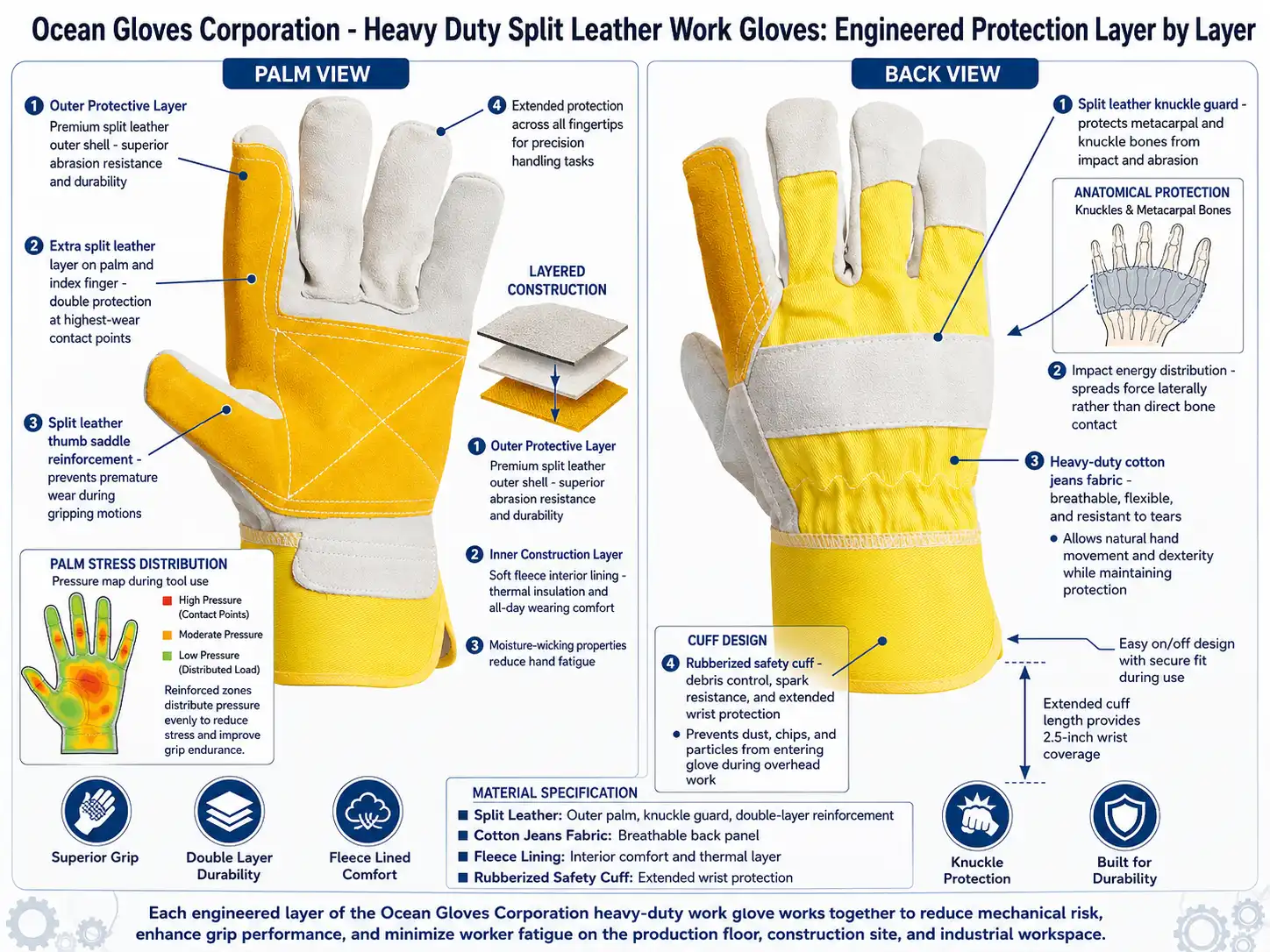
Heavy Duty Work Glove Construction Designed for High-Stress Environments
The outer shell material determines abrasion resistance and durability. We primarily use cowhide split leather because it resists tearing and withstands repeated contact with rough surfaces like concrete, metal edges, and wooden beams. Full-grain leather provides superior strength and a more refined feel when the application requires enhanced tactile feedback, such as precision assembly tasks in industrial settings. The tanning process stabilizes the leather fibers to prevent premature cracking and stiffening, which is critical for gloves worn during long shifts.
Double-palm construction adds a second leather layer to the palm area, significantly extending service life in applications where workers grip tools or materials for hours each day. This reinforcement distributes abrasion loads across a thicker surface rather than concentrating stress on a single layer, which delays the point at which the material wears through. We position thumb saddle patches and fingertip reinforcements at anatomical contact zones where grip pressure peaks, using industrial-grade thread that matches the leather's tensile strength.
Inner liners contribute to comfort and specific protective functions, depending on the hazard profile. Cotton or jersey liners wick moisture away from the skin, reducing irritation during extended wear in warm environments. For cold-weather operations, we incorporate Thinsulate or interlock knit liners that provide thermal insulation without adding excessive bulk that would compromise dexterity. Some liner configurations include cut-resistant fibers that act as an internal barrier against sharp objects, though the exact specification depends on whether the buyer requires documented cut resistance under EN 388 or ANSI/ISEA 105.
Thread specification matters more than most buyers realize. Standard polyester thread fails under the mechanical loads heavy duty gloves experience, leading to seam separation at stress points. We use reinforced threads with higher tensile strength, and we double-stitch high-wear seams to prevent unraveling when one stitch line weakens. The stitching pattern itself affects durability: overlapping seams at the thumb crotch and index finger base reduce the likelihood of tearing during gripping motions.
Impact protection, where relevant, requires thermoplastic rubber (TPR) padding or foam inserts placed over the knuckles and metacarpal bones. These components absorb and dissipate blunt force energy before it reaches the hand, reducing injury risk when workers accidentally strike hard surfaces or when tools slip during use. The shape and thickness of the impact shield must balance protection with finger mobility, which we confirm through product-specific testing according to ANSI/ISEA 138 when impact claims are part of the specification.
Cuff design controls debris entry and affects removal speed. Longer cuffs prevent dust, chips, and sparks from sliding into the glove during overhead work, which is particularly important in welding and metal fabrication. Elastic or knit cuffs provide a snug fit that stays in place during active tasks, while safety cuffs allow quick removal in emergencies. We configure cuff length and closure type based on the intended application and the buyer's workplace safety protocols.
Physics and Materials: Why Leather Remains the Benchmark for Heavy Duty Work Gloves
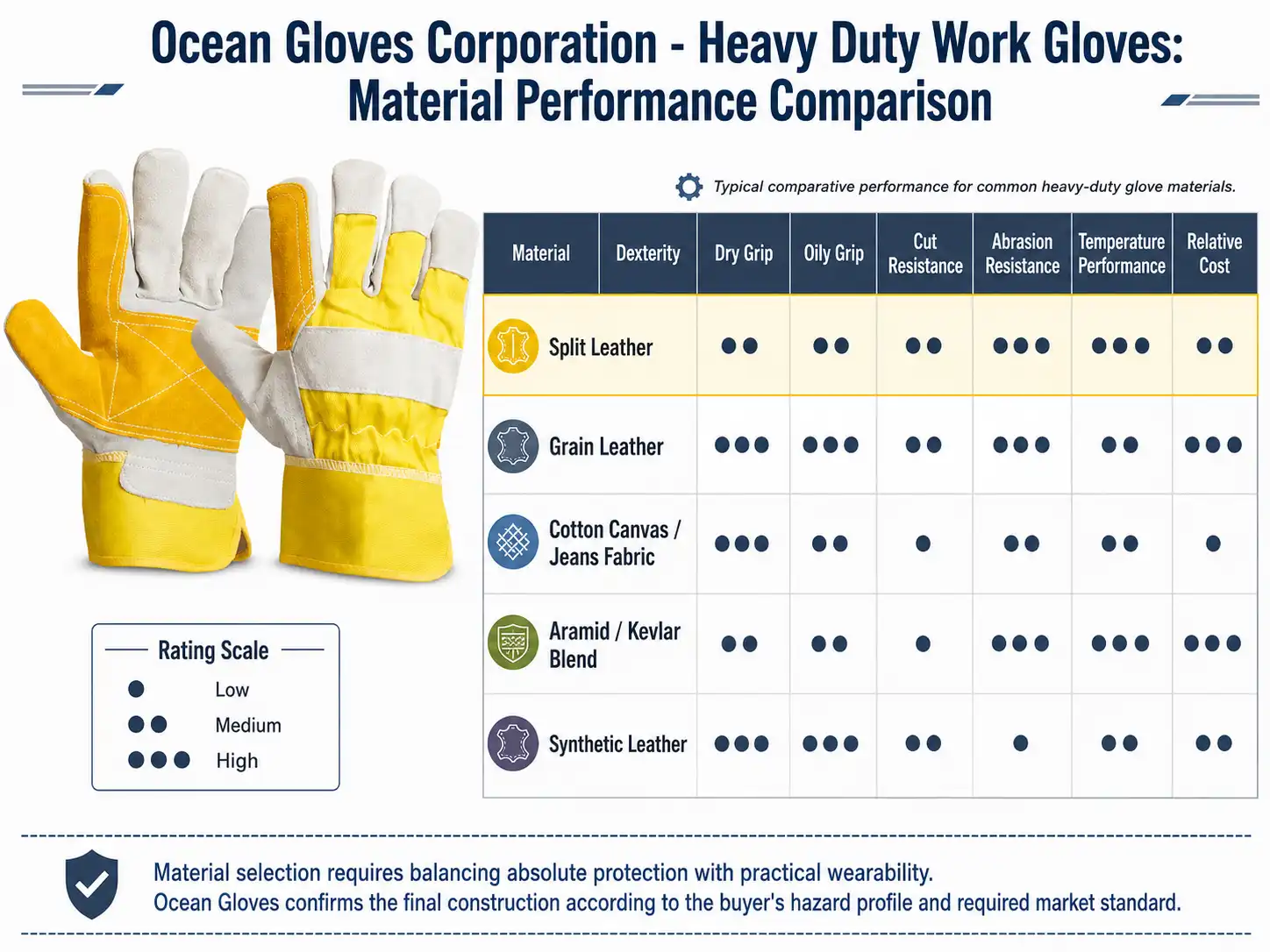
Cowhide split leather balances durability, abrasion resistance, and cost efficiency better than most alternatives for heavy duty applications. Split leather comes from the lower fibrous layers of the hide, which are naturally thick and resistant to tearing. This material withstands repeated friction against rough surfaces without wearing through as quickly as synthetic alternatives, making it ideal for construction, demolition, and warehousing tasks. The trade-off is slightly less tactile sensitivity compared to full-grain leather, but the durability gain justifies this compromise for most industrial buyers.
Full-grain leather, cut from the top layer of the hide, retains the natural grain structure and provides superior strength and flexibility. This material offers better dexterity and a more refined feel, which matters for tasks requiring precise hand movements, such as mechanical assembly or fine tool handling. Full-grain leather costs more and requires careful tanning to maintain its protective properties without becoming stiff, but for applications where worker comfort directly affects productivity, the investment pays off.
Synthetic materials like nitrile coatings or PVC overlays enhance grip and chemical resistance when applied to leather palms. Nitrile resists oils, greases, and many industrial solvents, improving grip in wet or oily conditions while providing a barrier against skin contact with harmful substances. PVC coatings also offer good chemical resistance and abrasion protection, though they perform less effectively in extreme cold. We apply these coatings strategically to palm and finger areas rather than covering the entire glove, which preserves breathability and reduces hand fatigue during long shifts.
Kevlar liners add cut resistance when the task profile includes frequent contact with sharp edges. Kevlar fibers resist cutting better than leather alone, acting as an internal barrier that reduces injury risk during handling of metal stock, glass, or sharp-edged materials. However, Kevlar adds bulk and reduces flexibility, so we recommend this construction only when the cut hazard justifies the dexterity trade-off. The final EN 388 cut level depends on the Kevlar grade and liner thickness, which we confirm through product-specific testing.
Impact dissipation in TPR-backed gloves depends on the foam's compression characteristics and recovery speed. When a worker's knuckles strike a hard surface, the TPR compresses and spreads the impact energy laterally across a larger area rather than allowing it to concentrate at the contact point. The material must recover quickly enough to protect against repeated impacts during the same shift, which requires selecting TPR grades with specific durometer ratings. We design TPR placement to cover the knuckles and metacarpal bones without interfering with finger flexion, maintaining the balance between protection and usability.
Heat management affects worker comfort and glove lifespan. Leather naturally breathes better than synthetic materials, allowing moisture vapor to escape and reducing sweat buildup inside the glove. This property matters during physically demanding tasks in warm environments, where excessive sweating leads to hand fatigue and increases the likelihood of blisters. However, thick leather or multiple layers reduce breathability, so we calibrate material thickness and liner selection to match the expected work intensity and ambient temperature.
Dexterity versus thickness represents the core trade-off in heavy duty glove design. Thicker materials provide more protection and longer service life but reduce tactile feedback and finger mobility, which can slow task completion and increase error rates. We specify material thickness based on the hazard severity and task precision requirements: thicker construction for demolition and rough material handling, thinner construction for mechanical assembly and tool-intensive work. Contact us for guidance on the exact construction path that matches your hazard profile and productivity targets.
Raw to Box Process in Sialkot: How We Control Quality from Leather Selection to Export Packing
Incoming raw material inspection begins with hide selection at our in-house tannery. We grade cowhide by thickness, grain consistency, and defect presence, rejecting hides with excessive scarring, uneven thickness, or weak fiber structure. This initial sorting determines final glove quality more than any downstream process correction can achieve. After grading, we measure each hide batch for dimensional consistency, ensuring uniform material properties across production runs.
Material preparation and treatment follow tannery-specific protocols developed over 25 years of direct manufacturing. We process hides through chrome tanning to stabilize the collagen fibers, preventing decomposition and improving resistance to moisture and temperature fluctuations. The tanning bath chemistry and duration affect leather flexibility and strength, which we calibrate to produce the firmness and drape characteristics required for heavy duty work gloves. After tanning, we tumble and condition the leather to achieve the target softness without sacrificing abrasion resistance.
Precision cutting for dimensional consistency uses die-cutting machines that stamp glove components from prepared leather sheets. We maintain cutting dies to tight tolerances, ensuring palm pieces, back panels, thumb pieces, and finger panels match the pattern specifications within millimeters. Dimensional accuracy at this stage prevents fit problems later, reducing the rejection rate during final assembly and improving worker comfort when the glove is worn. We batch-cut components from the same leather lot to maintain color and texture consistency across each production order.
Liner or inner component preparation runs parallel to leather cutting when the specification includes an inner layer. We source cotton, jersey, or Kevlar liners from local suppliers whose materials we pre-qualify through testing. Liner dimensions must match the outer shell dimensions to prevent bunching or gaps that create discomfort or reduce protection. For gloves requiring thermal insulation, we cut Thinsulate panels to precise shapes that align with palm and back panel contours, ensuring even heat distribution without adding excessive bulk.
Assembly sequence and reinforcement of high-wear zones follow engineered work instructions specific to each glove model. Stitchers join palm and back panels using reinforced thread, placing double-stitch lines at thumb crotch, index finger base, and pinky finger edges where stress concentrates during gripping motions. We attach thumb saddle patches and fingertip reinforcements before closing finger seams, allowing the stitcher to secure these components without fighting material bunching. Reinforcement placement follows anatomical maps that identify where workers apply the most pressure during typical tasks.
Impact component bonding or stitching, when relevant, secures TPR padding to the back panel before final assembly. We use industrial adhesive or reinforced stitching to attach impact shields over knuckle and metacarpal zones, ensuring the padding remains in position during repeated compression and recovery cycles. The bonding method depends on the TPR type and the expected impact frequency: adhesive bonding for light-duty impact protection, stitched attachment for heavy-duty applications where adhesive alone might fail under repeated stress.
In-process quality checks occur at each station, catching defects before they compound downstream. Stitchers inspect seam integrity immediately after closing each finger, checking for skipped stitches, uneven tension, or misaligned panels. Supervisors measure finished glove dimensions against pattern specifications, using calipers to verify palm width, finger length, and cuff circumference. We pull random samples from each batch for destructive testing, measuring seam strength, material tear resistance, and reinforcement attachment durability.
Final AQL-style inspection follows international sampling standards, examining visual appearance, dimensional accuracy, and functional performance. Inspectors check for cosmetic defects like staining, uneven coloring, or loose threads, as well as functional issues like weak seams, misaligned fingers, or poorly attached reinforcements. We measure a statistically valid sample from each production lot, applying accept/reject criteria based on the defect severity and frequency. This process maintains our 0.8% defect rate by catching problems before packing.
Export packing prepares gloves for international shipment, protecting them from moisture, contamination, and physical damage during transit. We pack gloves in polyethylene bags, then consolidate them into cartons labeled with product specifications, quantity, and destination details. Compliance hang-tags display CE marking, EN 388 digits, ANSI levels, or other required information depending on the target market. We seal cartons and palletize them according to shipping line requirements, ensuring containers arrive at USA, UK, or EU ports without damage.
Direct factory control helps international buyers with consistent quality, traceability, and cleaner audit documentation compared to trading companies. When you source from a manufacturer, you verify production processes through factory audits, reviewing tannery operations, stitching stations, and quality control procedures firsthand. Trading companies obscure the actual production source, making it difficult to trace material origins or confirm compliance with labor and environmental standards. Our SEDEX registration, SMETA report, and BSCI audit provide transparency that procurement managers need for supplier qualification and ongoing compliance monitoring.
Technical DNA: Heavy Duty Work Glove Specification Framework
Below is the original specification block preserved and formatted in a table for easier reading. The content itself is unchanged.
Industries, Applications, and Risk Scenarios Where Heavy Duty Work Gloves Prevent Injuries
Construction workers face extreme abrasion when handling rebar, concrete forms, and lumber throughout the workday. Standard work gloves wear through at the palm and fingertips within days, forcing workers to choose between replacing gloves frequently or continuing with compromised protection. Heavy duty work gloves with double-palm reinforcement and reinforced fingertips spread abrasion loads across thicker leather layers, extending glove life and maintaining protection consistency. The wrong glove choice leads to hand lacerations from rebar burrs, splinters from rough-cut lumber, and blisters from repetitive gripping, which reduce productivity and increase injury claims.
Oil and gas field technicians torque pipe connections, handle heavy wrenches, and grip metal stock in environments where oily surfaces reduce grip reliability. Standard gloves slip when contaminated with oil, increasing the likelihood of tool drops and hand injuries. Heavy duty work gloves with nitrile-coated palms maintain grip in oily conditions while providing abrasion resistance during tool handling and pipe manipulation. Without proper grip and abrasion protection, workers experience hand fatigue earlier in the shift, leading to errors and safety incidents during critical tasks.
Welding and metal fabrication workers handle hot metal stock, sharp-edged steel plates, and heavy fabrication tools that combine heat, cut, and impact hazards. Light-duty gloves burn through quickly when exposed to spatter and radiant heat, and they lack the abrasion resistance needed for handling rough metal surfaces. Heavy duty leather welding gloves resist heat penetration better than synthetic alternatives, and they tolerate the abrasion from dragging metal stock across workbenches. Poor glove selection results in burn injuries, cut injuries from sharp metal edges, and reduced productivity as workers stop frequently to replace damaged gloves.
Warehouse and logistics workers move pallets, unload containers, and handle packaged goods with rough cardboard surfaces and sharp-edged banding straps. The repetitive gripping and lifting motions concentrate wear at the palm and fingertips, wearing through thin gloves rapidly. Heavy duty work gloves extend service life by reinforcing high-contact zones, reducing the per-task cost of hand protection. Without adequate abrasion resistance, workers develop hand fatigue and blisters that slow picking rates and increase the risk of dropping loads.
Mining and heavy equipment operators grip control levers, handle maintenance tools, and work in environments with sharp rock edges and abrasive dust. Gloves must resist both mechanical abrasion and provide enough dexterity for precise control inputs. Heavy duty work gloves balance thickness for durability with flexibility for control feel, preventing the hand fatigue that reduces reaction time during equipment operation. Inadequate glove durability forces workers to replace gloves frequently, and inadequate dexterity increases the likelihood of control errors during critical machine operations.
Standards and Compliance Explained: What EN 388, ANSI, CE, and Audit Documentation Mean for Heavy Duty Work Gloves
EN 388:2016+A1:2018 assesses glove performance against mechanical risks, rating abrasion resistance, cut resistance, tear resistance, puncture resistance, and impact resistance using a standardized test protocol. The abrasion test measures how many cycles a glove material withstands on a rotating abrasive surface before wearing through, with results ranging from Level 1 (lowest) to Level 4 (highest). Cut resistance testing follows ISO 13997 TDM methodology for materials that dull the standard Coup test blade, providing a gram-force measurement that correlates to real-world cut protection. Tear and puncture tests measure the force required to propagate a tear or puncture the material, indicating how the glove performs when snagged or struck by pointed objects.
Buyers must confirm exact EN 388 digits by construction variant because material thickness, leather grade, and liner composition directly affect test results. A heavy duty work glove built with thick cowhide split leather may achieve Level 4 abrasion resistance, while a thinner construction using the same base material might only reach Level 3. We cannot state a universal EN 388 performance level for all heavy duty work gloves because the final digits depend on the specific build you select. Contact us for the exact EN 388 performance profile for this product because digits vary by construction variant.
ISO 13997 TDM cut testing matters for cut-resistant gloves because it measures the force required to cut through the material under controlled conditions, providing a quantitative result that buyers can compare across glove types. The TDM test uses a blade mounted on a motorized sled, applying increasing force until the blade cuts through the sample. Results appear as gram-force values rather than simple letter grades, giving procurement managers a more precise understanding of cut protection. When a buyer's hazard assessment identifies specific cut risks, we recommend specifying the required gram-force threshold rather than accepting a generic cut-resistant label.
EN ISO 21420 or EN 420 establishes general glove requirements, including sizing accuracy, comfort specifications, material innocuousness, and marking requirements. This standard ensures gloves fit consistently across size ranges, preventing gaps or excessive tightness that reduce protection or cause discomfort. Innocuousness testing confirms the glove materials do not contain harmful substances that cause skin irritation or allergic reactions during extended wear. Marking requirements mandate that manufacturers clearly label gloves with performance levels, size information, and care instructions, which helps buyers verify they receive the specified product.
ANSI/ISEA 105 provides the US cut level framework, categorizing gloves from A1 (lowest cut resistance) to A9 (highest cut resistance) based on ASTM F2992-15 TDM cut testing. This standard matters for US buyers because it aligns with OSHA PPE regulations and internal workplace safety programs that reference ANSI levels when specifying hand protection. The ANSI cut level must match the cut hazard severity workers face, which we determine through a combination of task analysis and material selection. We cannot claim a specific ANSI cut level for all heavy duty work gloves without knowing the liner composition and material thickness you require, so we confirm this through product-specific testing after you finalize the specification.
ANSI/ISEA 138 addresses impact protection for gloves, defining test methods and performance criteria for knuckle guards and dorsal impact shields. The standard measures the force transmitted through the glove material when struck by a weighted drop, assigning a pass/fail result based on whether the transmitted force stays below the injury threshold. Impact claims must match product-specific testing because TPR thickness, placement, and material properties vary across glove models. We design certain heavy duty models to incorporate features that comply with this standard, but we verify performance through testing rather than assuming compliance based on similar models.
CE marking signifies that heavy duty work gloves meet EU safety, health, and environmental protection requirements, demonstrating conformity with relevant EN standards. For gloves, CE marking typically involves conformity assessment procedures related to EN 388, EN 420, and EN 407 (for thermal protection) where applicable. The CE mark confirms that the manufacturer has evaluated the product against the stated performance levels and maintains technical documentation proving compliance. It is a mandatory conformity mark for products sold within the European Economic Area, which buyers must verify through documentation review and, where required, notified body certification.
UKCA marking replaced CE marking for products sold in Great Britain after Brexit, requiring manufacturers to demonstrate compliance with UK-specific safety regulations. The technical requirements remain largely aligned with EN standards, but the marking itself differs, and manufacturers must provide a UK Conformity Assessment. For heavy duty work gloves exported to the UK market, we provide UKCA documentation alongside performance test reports, ensuring smooth customs clearance and legal market access.
SEDEX, BSCI, SMETA, and SA8000 audits address supplier ethical trade performance, evaluating labor practices, health and safety, environmental management, and business ethics. International buyers require these audits to demonstrate supply chain responsibility and meet corporate social responsibility commitments. Our SEDEX registration and SMETA audit results provide transparency into our manufacturing processes, confirming we do not employ child labor, we maintain safe working conditions, and we comply with local labor laws. This documentation simplifies supplier qualification for procurement managers who must verify ethical sourcing before approving new vendors.
OEM and Private Label for USA, UK, and EU Brands: How We Support Your Product Line
Logo placement follows your brand guidelines, with options including embossed leather logos on the back panel, embroidered logos on the cuff, or printed logos on hang-tags and packaging. Embossed logos provide a subtle, professional appearance that matches premium glove positioning, while embroidered logos offer higher visibility and brand recognition on the job site. We position logos to avoid high-wear zones where abrasion would degrade the branding over time, and we confirm placement with you through sample approval before commencing production.
Material and color options depend on the available leather grades and dye capabilities within our supply chain. Standard heavy duty work gloves use natural or brown leather, which hides dirt and wear better than lighter colors during industrial use. We can produce black, gray, or other colors if your brand identity requires specific color matching, though dye consistency depends on the leather batch and tanning process. Contact us with your color specifications so we can confirm feasibility and provide dyed samples for approval.
TPR colors, where relevant, allow customization for brand differentiation or high-visibility requirements. We offer standard black, gray, or yellow TPR padding, with custom colors possible at higher MOQs due to the need for dedicated production runs. Yellow or orange TPR improves glove visibility in low-light environments, which matters for safety programs emphasizing high-visibility PPE across all equipment. We confirm TPR color options during the specification phase and provide color samples before finalizing the order.
Cuff style affects both debris control and branding visibility. Knit wrist cuffs provide a snug fit that prevents debris entry during overhead work, while elastic cuffs offer easier on-off functionality during frequent glove changes. Safety cuffs extend coverage up the forearm, protecting the wrist and lower arm from sparks, debris, and abrasion in welding and grinding applications. We configure cuff length, closure type, and color according to your application requirements and brand preferences.
Packaging type ranges from simple polyethylene bags for bulk shipments to branded retail-style packaging with product photos, feature callouts, and hang-tags displaying compliance information. Retail packaging increases per-unit cost but supports premium positioning and point-of-sale display in distributor showrooms. We design packaging layouts to your specifications, incorporating brand colors, logos, and product imagery that align with your marketing materials.
Compliance hang-tag labeling for CE, UKCA, and ANSI markets must display performance levels, care instructions, and manufacturer information according to regulatory requirements. We print hang-tags with the exact EN 388 digits, ANSI cut levels, or ANSI/ISEA 138 impact statements relevant to your product specification, ensuring the labeling matches the test documentation. This accuracy matters for audit compliance and customer confidence, as mislabeled gloves create liability risk and damage brand reputation.
Repeat order documentation continuity ensures you receive consistent product specifications across reorders without needing to resubmit detailed technical requirements each time. We maintain technical files for each private label client, recording material specifications, logo placement, packaging details, and compliance documentation. When you place a repeat order, we reference the existing file and confirm any specification changes before production, reducing lead time and eliminating the risk of miscommunication.
OEM and private label order ranges typically start at 1,000 to 2,000 pairs depending on the customization depth. Simple logo embossing or cuff embroidery may qualify for lower MOQs, while custom TPR colors, unique packaging designs, or proprietary material specifications require higher volumes to justify tooling and setup costs. Trial orders start from 100 pairs, allowing you to evaluate our manufacturing quality, fit consistency, and compliance documentation before committing to a full private label program.
Why Global Buyers Choose a Sialkot Manufacturer for Heavy Duty Work Gloves
Sialkot concentrates Pakistan's glove manufacturing ecosystem, housing leather tanneries, stitching workshops, thread suppliers, and packaging manufacturers within a compact geographic area. This cluster reduces logistics complexity and allows manufacturers to source components locally rather than importing from distant suppliers, which improves lead time consistency and simplifies quality control. When a buyer works with a Sialkot-based manufacturer, they benefit from the accumulated expertise of a region that has specialized in leather goods production for over a century.
Skilled labor depth in Sialkot provides access to stitchers and pattern makers who understand the biomechanics of hand protection and the engineering requirements of industrial gloves. These workers learn glove construction through apprenticeships that transfer knowledge across generations, developing the hand-eye coordination and material intuition needed to produce consistent results. This labor pool allows us to scale production during peak demand periods without sacrificing quality, which trading companies cannot guarantee when they rely on subcontractors with fluctuating capacity.
The leather and PPE supply chain in Sialkot includes raw hide suppliers, chrome tanning facilities, thread manufacturers, and TPR component producers, all competing for business within the local market. This competition drives quality improvement and price efficiency, benefiting manufacturers who can select from multiple suppliers for each component. When a problem arises with a material batch, we switch suppliers quickly without disrupting production schedules, maintaining delivery commitments to international buyers.
Direct sourcing from a Sialkot manufacturer reduces trading company markups and communication gaps that increase project risk. Trading companies add 15% to 30% margin on top of manufacturing cost, which you pay without receiving additional value in terms of quality control or specification accuracy. Communication delays compound when buyers must route technical questions through a trader who lacks manufacturing expertise, leading to misunderstandings and specification errors that only surface when the shipment arrives. By working directly with Ocean Gloves, you communicate with engineers and quality managers who understand material science and can answer technical questions in real time.
Ocean Gloves operates as a long-term manufacturing partner rather than a transactional supplier, investing in relationship-building and technical support that help buyers optimize their PPE programs. We review your hazard assessment data and recommend glove specifications that match the actual risks workers face, rather than simply fulfilling an order for whatever you specify. This consultative approach reduces costly specification mistakes and improves worker safety outcomes, which strengthens your company's safety performance metrics over time.
USA buyers benefit from our 25+ years of direct export experience, which means we understand FDA, CPSC, and CBP import requirements and can provide the documentation customs brokers need for smooth clearance. We structure invoices, packing lists, and certificates of origin according to US import regulations, reducing the likelihood of shipment delays or rejected containers at the port. Our familiarity with US safety standards like ANSI/ISEA 105 and ANSI/ISEA 138 ensures we provide test documentation in the format your internal safety team requires for PPE approval.
UK and EU buyers appreciate our compliance with CE and UKCA marking requirements, as well as our participation in SEDEX and BSCI audit programs that demonstrate ethical manufacturing practices. We maintain technical files documenting EN 388 and EN 420 conformity, including material certificates, test reports, and risk assessments that satisfy notified body requirements for Category II or Category III PPE. This documentation simplifies your supplier qualification process and supports your corporate social responsibility reporting.
Since 1992, we have refined our manufacturing processes through continuous feedback from international buyers, incorporating lessons learned from field failures, compliance audits, and evolving safety standards. This experience allows us to anticipate potential specification issues before they affect production, such as material availability constraints, testing timeline requirements, or packaging regulation changes. Newer manufacturers lack this historical perspective, which increases the risk of unexpected delays and quality problems during your first orders.
Common Specification Mistakes Buyers Make When Sourcing Heavy Duty Work Gloves
Mistake 1: Specifying a cut resistance level without confirming the test method used.
Some manufacturers claim "cut resistant" without specifying whether they tested to EN 388 ISO 13997, ANSI/ISEA 105 ASTM F2992-15, or an unvalidated internal method. When test methods differ, performance claims cannot be compared directly, and buyers may receive gloves that fail to protect against the actual cut hazards workers face. Correct specification requires stating the required test method and performance threshold, such as "ANSI A4 cut resistance per ASTM F2992-15" or "EN 388 Level D cut resistance per ISO 13997."
Mistake 2: Ordering the thickest available leather without considering dexterity impact on task performance.
Thicker leather provides more abrasion resistance and longer glove life, but it also reduces tactile feedback and finger flexibility, which slows task completion and increases error rates during precision work. Workers often remove excessively thick gloves to complete detailed tasks, eliminating hand protection entirely. Correct specification balances protection against the actual abrasion severity with the dexterity required for the job, which we determine through task analysis and worker input.
Mistake 3: Assuming all "heavy duty" gloves meet the same performance standards across suppliers.
"Heavy duty" is a marketing term rather than a technical specification, so it carries no standardized meaning regarding abrasion resistance, cut protection, or impact performance. One manufacturer's heavy duty glove may use thin split leather with minimal reinforcement, while another uses double-palm construction with reinforced stitching. Correct specification requires stating measurable performance requirements such as "double-palm cowhide split leather with reinforced thumb saddle and fingertip patches" rather than relying on generic descriptors.
Mistake 4: Ignoring cuff length and closure type, which affect debris control and removal speed.
Cuff design determines whether dust, chips, and sparks enter the glove during overhead work, and it affects how quickly workers can remove gloves in emergencies. Short knit cuffs work well for general material handling but allow debris entry during grinding or cutting operations. Safety cuffs protect the wrist and lower arm but slow removal during emergency situations. Correct specification requires matching cuff design to the task's debris profile and emergency response requirements.
Mistake 5: Selecting gloves based solely on the lowest unit price without evaluating total cost of ownership.
Inexpensive gloves often wear out faster, requiring more frequent replacement and increasing the total cost per task completed. A glove priced 20% lower but lasting half as long costs 60% more over time, not including the productivity loss from frequent glove changes. Correct procurement evaluates glove lifespan, replacement frequency, and productivity impact alongside unit price, focusing on cost per hour of protection rather than cost per pair.
How to Brief Your Safety Team About Heavy Duty Work Gloves from Ocean Gloves
Start by collecting injury data and task analysis to identify where hand injuries occur and what hazards cause them. Review OSHA 300 logs, workers' compensation claims, and near-miss reports to quantify the frequency and severity of hand injuries in each work area. Conduct task observations to document the specific materials workers handle, the grip forces they apply, the duration of exposure, and the environmental conditions they work in. This data provides the foundation for matching glove specifications to actual risks rather than guessing at protection requirements.
Present EN 388, ANSI/ISEA, CE, and UKCA compliance language in terms your safety team understands, explaining what each performance level means for worker protection. For example, "EN 388 Level 4 abrasion resistance means the glove material withstood at least 8,000 cycles on the abrasion tester, which translates to approximately X weeks of service life in our rebar handling operation." Translating technical specifications into real-world outcomes helps safety managers justify the glove selection to budget holders and gain worker buy-in for PPE compliance.
Address worker comfort and PPE compliance by explaining how proper fit, breathability, and dexterity affect whether workers actually wear the gloves throughout their shifts. Uncomfortable or poorly fitting gloves get removed during tasks, eliminating protection entirely. Schedule worker trials with sample gloves before committing to large orders, collecting feedback on fit, comfort, dexterity, and durability. Workers who participate in glove selection are more likely to comply with PPE requirements because they understand the decision rationale and trust that their input was considered.
Questions to ask the current supplier include: What is the exact EN 388 or ANSI performance level for these gloves, and can you provide test documentation? What is the average service life per pair in our specific application? What is the defect rate, and how do you handle warranty claims? Where are the gloves manufactured, and can we audit the factory? What ethical trade certifications do you hold? These questions expose suppliers who cannot substantiate their claims and help you differentiate between credible manufacturers and trading companies obscuring their supply chain.
Documentation to request before approving a supplier includes: EN 388 or ANSI/ISEA test reports from accredited labs, material certificates confirming leather type and treatment, SEDEX or BSCI audit reports demonstrating ethical manufacturing, ISO 9001 certification proving quality management system implementation, and customer references from buyers in similar industries. Reviewing this documentation before issuing a purchase order reduces the risk of receiving non-compliant product or discovering ethical violations after you commit to the supplier.
Specification Scenario for a Real-World Hand Protection Problem
A metal fabrication facility in the Midwest USA employs 40 workers who cut, grind, and assemble steel components for industrial machinery. Workers handle sharp-edged steel plates, operate angle grinders, and use hand tools in an environment with metal chips, grinding dust, and oil-contaminated surfaces. The safety manager tracks frequent hand injuries: lacerations from sharp edges, abrasions from handling rough metal stock, and impact injuries when tools slip and strike knuckles. Workers report that their current gloves wear through at the palm and fingertips within one to two weeks, forcing frequent replacements and creating budget pressure.
The technical mismatch in the previous glove specification stemmed from selecting general-purpose work gloves with single-layer leather palms and no cut resistance documentation. These gloves provided basic abrasion protection but lacked the palm reinforcement needed for the repetitive gripping and handling motions workers performed during metal cutting and assembly. The absence of confirmed cut resistance meant workers remained at risk from sharp-edged steel plates, and the lack of impact protection left knuckles vulnerable when tools slipped during grinding operations. Glove lifespan averaged 8 to 10 work days, which translated to approximately 300 pairs consumed per month across the workforce.
The transition to a better dual-protection specification involved selecting heavy duty work gloves with double-palm cowhide split leather construction, Kevlar liner for cut resistance, and TPR knuckle guards for impact protection. The facility's safety manager worked with Ocean Gloves to match the glove specification to the actual hazards documented in injury records and task observations. We recommended ANSI A4 cut resistance per ASTM F2992-15 based on the steel plate handling frequency, double-palm construction to address the accelerated palm wear, and TPR knuckle protection meeting ANSI/ISEA 138 impact criteria based on the tool-slip incidents.
The expected protection and compliance improvement includes reduced laceration incidents from better cut resistance, extended glove lifespan from palm reinforcement, and lower knuckle injury risk from impact protection. The facility will monitor injury rates and glove replacement frequency over a six-month trial period to quantify the improvement and calculate the total cost of ownership compared to the previous gloves. Workers participate in the trial by providing feedback on comfort, dexterity, and any tasks where the new gloves create challenges, which allows the safety manager to refine the specification if needed.
Send your RFQ via WhatsApp or email.
FAQs
Q1: What specific types of cowhide leather does Ocean Gloves use in heavy duty work gloves, and how does split leather differ from full-grain leather in protection and durability?
We primarily use cowhide split leather and full-grain leather, selecting the appropriate type based on the application's abrasion severity and dexterity requirements. Cowhide split leather comes from the lower fibrous layers of the hide, providing excellent durability and abrasion resistance at a cost-effective price point, which makes it ideal for heavy construction, demolition, and warehouse applications. Full-grain leather, cut from the top layer, retains the natural grain structure and offers superior strength, flexibility, and tactile sensitivity, which matters for mechanical assembly and precision tool work. The tanning process we use stabilizes the leather fibers to prevent premature cracking and maintains the natural protective properties while ensuring comfort during long shifts. Contact us with your specific application details so we can recommend the optimal leather grade for your hazard profile.
Q2: How does Ocean Gloves' in-house tannery in Sialkot improve quality consistency compared to sourcing leather from external suppliers?
Our in-house tannery allows complete control over hide selection, tanning chemistry, and finishing processes from the moment raw hides arrive until the leather enters glove production. We grade hides by thickness, grain consistency, and defect presence, rejecting materials that would create weak spots or premature failures in the finished glove. The tanning bath chemistry and duration affect leather flexibility and strength, which we calibrate to produce the firmness and drape characteristics required for heavy duty work gloves. External leather suppliers introduce variability because their processing targets different end uses, and they prioritize volume throughput over the specific performance requirements our gloves demand. Direct tannery control eliminates the batch-to-batch inconsistency that causes glove quality to fluctuate when sourcing from multiple suppliers, which is why our defect rate remains at 0.8% while competitors struggle with 3% to 5% defect rates.
Q3: What engineering principles determine the placement of palm reinforcements and thumb saddle patches in heavy duty work gloves?
We position reinforcements at anatomical contact zones where grip pressure peaks during typical manual tasks, using biomechanical analysis and wear pattern data collected from field-tested gloves. The palm patch covers the area from the base of the fingers to the heel of the hand, where workers apply the most pressure when gripping tools, lifting materials, or pushing objects. Thumb saddle reinforcement protects the high-friction zone where the thumb opposes the fingers during gripping motions, which experiences concentrated wear during repetitive tasks. Fingertip patches address the contact points where workers pinch small objects or feel for edges during positioning tasks, preventing premature wear in areas where the glove material thins naturally due to stretching. This strategic reinforcement distributes abrasion loads across thicker leather layers rather than allowing stress to concentrate on single points, which extends glove lifespan by a factor of two to three compared to unreinforced construction.
Q4: How do coating materials like nitrile and PVC affect grip performance in oily versus dry conditions, and what trade-offs do they introduce?
Nitrile coatings provide excellent grip in oily, greasy, and wet conditions because the rubber compound resists oil penetration and maintains surface friction when contaminated. This property makes nitrile-coated heavy duty work gloves ideal for oil and gas operations, automotive maintenance, and metal fabrication where workers handle oil-contaminated tools and parts. PVC coatings also offer good grip in wet conditions and provide better chemical resistance against acids and alkalis, though they perform less effectively in extreme cold where the material stiffens. The trade-off with any coating is reduced breathability compared to uncoated leather, which increases moisture buildup inside the glove during physically demanding tasks in warm environments. We apply coatings strategically to palm and finger areas only, leaving the back panel uncoated to preserve air circulation and reduce hand fatigue during extended wear.
Q5: What is the purpose of double-stitched seams in heavy duty work gloves, and how does thread grade affect seam durability under heavy loads?
Double-stitched seams create redundancy at high-stress zones, ensuring the glove remains intact even if one stitch line weakens or breaks during use. We place double-stitch lines at the thumb crotch, index finger base, and pinky finger edges where gripping forces concentrate and material movement is most aggressive. Thread grade directly affects seam durability because standard polyester thread fails under the mechanical loads heavy duty gloves experience, leading to seam separation at stress points. We use reinforced threads with higher tensile strength, matching the thread specification to the leather's material properties to ensure the thread does not become the weak link in the construction. The stitching pattern itself also matters: overlapping seams distribute loads across a longer thread length rather than concentrating stress at single penetration points, which reduces the likelihood of tearing when the glove catches on sharp objects.
Q6: How does vertical integration at Ocean Gloves, including the in-house tannery, reduce lead times and improve quality control compared to competitors who source components externally?
Vertical integration eliminates the coordination delays and quality handoffs that occur when multiple suppliers provide different components. We control the entire process from raw hide selection through finished glove packing, which means we do not wait for external tanneries to deliver leather batches or for thread suppliers to fulfill orders before starting production. This control reduces our lead time to 30 to 45 days after PO confirmation, whereas competitors sourcing externally often require 60 to 90 days because they depend on supplier schedules outside their control. Quality improves because we inspect materials at each stage rather than accepting whatever arrives from external suppliers, catching defects before they enter the production line. When a problem arises, we correct it immediately within our facility instead of negotiating returns and replacements with outside vendors, which preserves delivery schedules and maintains consistent quality across production runs.
Q7: What impact does glove weight and material thickness have on worker fatigue during eight-hour shifts, and how does Ocean Gloves balance protection with wearability?
Glove weight and material thickness directly affect hand fatigue because workers must apply more grip force to hold tools and materials when wearing thick, heavy gloves. This increased muscular effort accumulates over an eight-hour shift, reducing productivity and increasing the likelihood of errors during the final hours when fatigue peaks. We calibrate material thickness and reinforcement placement to achieve the protection level required by the hazard profile without adding unnecessary bulk that would compromise dexterity and increase fatigue. For example, we use double-palm construction to extend durability in high-wear zones rather than thickening the entire glove, which maintains flexibility in the finger and back-of-hand areas where thickness does not contribute to protection. The balance between protection and wearability depends on the specific tasks workers perform and the duration of exposure, which is why we recommend discussing your application details with us before finalizing the specification.
Q8: What does the EN 388:2016+A1:2018 standard measure, and why is it important for heavy duty work gloves sold in the EU and UK markets?
EN 388:2016+A1:2018 assesses glove performance against mechanical risks, rating abrasion resistance, cut resistance, tear resistance, puncture resistance, and impact resistance using standardized test protocols. The abrasion test measures how many cycles a glove material withstands on a rotating abrasive surface before wearing through, with results ranging from Level 1 (lowest) to Level 4 (highest). Cut resistance testing follows ISO 13997 TDM methodology for materials that dull the standard Coup test blade, providing a gram-force measurement that indicates real-world cut protection. Tear and puncture tests measure the force required to propagate a tear or puncture the material, which tells buyers how the glove performs when snagged or struck by pointed objects. The standard is important for EU and UK markets because CE and UKCA marking require demonstrating conformity with EN 388 for gloves intended to protect against mechanical risks, and buyers reference these performance levels when specifying PPE for their workplace safety programs.
Q9: How do Ocean Gloves' heavy duty work gloves align with ANSI/ISEA 105 standards for hand protection in the USA market?
ANSI/ISEA 105 categorizes gloves from A1 (lowest cut resistance) to A9 (highest cut resistance) based on ASTM F2992-15 TDM cut testing, providing a standardized framework that US buyers use to specify cut protection levels. We design heavy duty work gloves to meet specific ANSI levels based on the liner composition and material thickness you require, confirming the exact cut level through product-specific testing after you finalize the specification. The ANSI framework also addresses abrasion resistance and puncture resistance using standardized test methods, though these performance areas receive less attention than cut resistance in most US safety programs. Because ANSI/ISEA 105 aligns with OSHA PPE regulations and internal workplace safety standards, US buyers prefer gloves labeled with ANSI levels rather than relying solely on EN 388 ratings, which is why we provide test documentation in both formats when exporting to the USA.
Q10: What is the significance of ANSI/ISEA 138 impact protection standards for heavy duty work gloves, and how does Ocean Gloves verify compliance?
ANSI/ISEA 138 defines test methods and performance criteria for gloves with impact protection, measuring the force transmitted through the glove material when struck by a weighted drop. The standard assigns a pass or fail result based on whether the transmitted force stays below the injury threshold, providing assurance that the impact shields effectively protect knuckles and metacarpal bones from blunt force trauma. Impact claims must match product-specific testing because TPR thickness, placement, and material properties vary across glove models, which means we cannot assume compliance based on similar designs. We verify ANSI/ISEA 138 compliance through testing at accredited labs, providing buyers with documentation that supports PPE approval in their workplace safety programs and demonstrates due diligence during regulatory audits.
Q11: How does CE marking on Ocean Gloves' heavy duty work gloves demonstrate compliance with EU safety regulations, and what documentation supports this claim?
CE marking signifies that our heavy duty work gloves meet EU safety, health, and environmental protection requirements, demonstrating conformity with relevant EN standards including EN 388 for mechanical risk protection and EN 420 for general glove requirements. The CE mark confirms we have evaluated the product against the stated performance levels and maintain technical documentation proving compliance, including material certificates, test reports from accredited labs, and risk assessments. We undergo conformity assessment procedures according to the PPE Regulation (EU) 2016/425, which may involve notified body certification for Category II or Category III gloves depending on the protection level and hazard complexity. This documentation is mandatory for legal market access in the European Economic Area, and we provide complete technical files to buyers who need to verify compliance during customs clearance or internal procurement reviews.
Q12: What role does ISO 9001:2015 certification play in Ocean Gloves' manufacturing operations, and how does it benefit international buyers?
ISO 9001:2015 certification demonstrates our commitment to a robust Quality Management System that ensures processes for design, development, production, and service are consistently monitored and improved to meet customer and regulatory requirements. The standard requires us to establish quality objectives, document procedures, train personnel, conduct internal audits, and implement corrective actions when problems arise, creating a systematic approach to quality rather than relying on inspection alone. For international buyers, ISO 9001:2015 certification provides confidence in the reliability, consistency, and traceability of our manufacturing processes, reducing the risk of receiving non-conforming product or encountering quality problems that disrupt your supply chain. The certification also simplifies supplier qualification for procurement managers who must verify manufacturing capability before approving new vendors, as it demonstrates we meet internationally recognized quality management standards.
Q13: How does Ocean Gloves' SEDEX registration and SMETA audit contribute to ethical manufacturing practices, and why does this matter for B2B buyers?
SEDEX registration and SMETA audits provide transparency into our labor practices, health and safety procedures, environmental management, and business ethics, demonstrating that we operate according to internationally recognized ethical trade standards. The SMETA audit framework evaluates working conditions, employee treatment, wage compliance, and freedom of association, verifying that we do not employ child labor, we maintain safe working conditions, and we comply with local labor laws. B2B buyers require this documentation to demonstrate supply chain responsibility and meet corporate social responsibility commitments, particularly when their customers or shareholders demand proof of ethical sourcing. SEDEX registration simplifies the audit process for buyers who need to verify multiple suppliers, as they can access our audit reports through the SEDEX platform without conducting separate factory inspections, which reduces supplier qualification costs and accelerates procurement timelines.
Q14: What does compliance with EN 12477 mean for heavy duty work gloves used in welding applications, and how does Ocean Gloves verify this standard?
EN 12477 is the European standard specifically for protective gloves for welding, addressing requirements for protection against heat, flame, flux, sparks, and mechanical risks relevant to welding operations. Gloves meeting this standard undergo testing for thermal resistance, flame resistance, contact heat resistance, and mechanical performance, ensuring they provide comprehensive hand protection against the unique hazards welders face. We verify EN 12477 compliance through testing at accredited labs, confirming that the leather grade, stitching, and construction we use meet the standard's performance criteria. This documentation matters for buyers who supply welding operations in the EU or UK, as it demonstrates the gloves are appropriate for the application and comply with workplace safety regulations governing welding PPE.
Q15: How does Ocean Gloves ensure compliance with NFPA 2112 for heavy duty work gloves designed for high-heat environments or flash fire protection?
NFPA 2112 establishes minimum requirements for flame-resistant and thermal protective clothing, including gloves, for industrial firefighters and workers exposed to flash fire hazards. Compliance requires testing the glove materials for flame resistance, heat resistance, and thermal insulation, ensuring they resist ignition, maintain protective integrity during exposure, and provide thermal insulation that prevents burn injuries. We verify NFPA 2112 compliance for specific glove models through testing at accredited labs, providing buyers with documentation that supports PPE approval in high-hazard environments such as oil refineries, petrochemical plants, and industrial firefighting operations. Not all heavy duty work gloves meet NFPA 2112 because the standard requires specific material properties and construction methods, which is why we confirm compliance on a product-by-product basis rather than applying the label broadly across our entire product line.
Q16: What is the typical Minimum Order Quantity for private label or OEM heavy duty work gloves from Ocean Gloves, and how does the customization process work?
Our standard MOQs for private label or OEM heavy duty work gloves typically range from 1,000 to 2,000 pairs, depending on the complexity of customization required. Simple logo embossing or cuff embroidery may qualify for the lower end of this range, while custom TPR colors, unique packaging designs, or proprietary material specifications require higher volumes to justify tooling and setup costs. The process begins with a detailed inquiry where you provide specifications for material type, protection level, branding requirements, and packaging design. We then provide a quotation including unit cost, tooling fees if applicable, and lead times for sample development and mass production. After you approve the quotation, we produce samples within 7 to 14 business days for your evaluation, and upon sample approval, we commence mass production with a lead time of 30 to 45 days after PO confirmation.
Q17: How does Ocean Gloves ensure brand consistency and quality for clients seeking private label heavy duty work gloves across multiple production runs?
We maintain strict adherence to your brand guidelines and product specifications throughout the manufacturing process, documenting every detail in technical files that we reference for repeat orders. Our quality assurance team conducts rigorous checks at multiple stages, from raw material inspection to final product inspection, ensuring that every pair of gloves leaving our factory meets your exact standards and reflects the quality your brand promises. We use the same leather batches, thread specifications, and construction methods across production runs to minimize variation, and we retain sample gloves from each lot for reference during future orders. Detailed documentation and communication are maintained throughout production, with progress updates and inspection reports available upon request so you can monitor quality before shipment. This systematic approach reduces the risk of specification drift that occurs when manufacturers rely on memory or incomplete records for repeat orders.
Q18: What information does Ocean Gloves require from a B2B buyer to provide an accurate quote for heavy duty work gloves?
To provide an accurate quote, we require detailed specifications including the type of heavy duty work gloves, desired material (specific leather type such as cowhide split leather or full-grain leather), required certifications (EN 388 levels, ANSI levels, CE marking, UKCA marking), quantity, any custom branding (logo placement, embroidery, or embossing), packaging preferences (bulk poly bags or retail-style boxes), and target delivery destination. This comprehensive information allows us to calculate material costs, manufacturing time, tooling requirements, and logistical expenses accurately, ensuring the quoted price reflects the actual production and shipping costs. Without complete specifications, quotes become estimates that may change during the order confirmation phase, which creates confusion and delays project timelines, so we encourage buyers to provide as much detail as possible in the initial inquiry.
Q19: What are the general production lead times for bulk orders of heavy duty work gloves from Ocean Gloves, and are expedited options available?
Our standard production lead time for bulk orders of heavy duty work gloves is 30 to 45 days after purchase order confirmation and approval of samples. This timeline includes material preparation at our in-house tannery, component cutting, glove assembly, in-process quality checks, final inspection, and export packing. For urgent requirements, we can explore expedited production and shipping options where feasible, though this may incur additional costs due to overtime labor, priority material sourcing, or air freight instead of sea freight. Expedited timelines depend on our current production schedule and material availability, so we recommend discussing your specific timeline needs with our sales team as early as possible to explore all available solutions and avoid unrealistic expectations.
Q20: How does Ocean Gloves handle international shipping and compliance documentation for B2B orders of heavy duty work gloves?
We have extensive experience exporting heavy duty work gloves to major international markets including the USA, UK, EU, Canada, and Australia, and we manage all necessary export documentation and customs compliance requirements. We offer various shipping terms including FOB Karachi (where you arrange shipping from the port), CIF destination port (where we arrange shipping and insurance to your port), and DDP door-to-door (where we handle all logistics and duties to your warehouse), allowing you to choose the option that best fits your logistics capabilities and cost structure. Our team prepares commercial invoices, packing lists, certificates of origin, and any special documentation required by your destination country's customs regulations, ensuring smooth clearance and minimizing the risk of shipment delays. We coordinate with freight forwarders experienced in PPE shipments, confirming that containers are properly loaded, sealed, and documented for international transit, and we provide tracking information so you can monitor shipment progress from Karachi to your destination.
Click To Contact Us Today!