

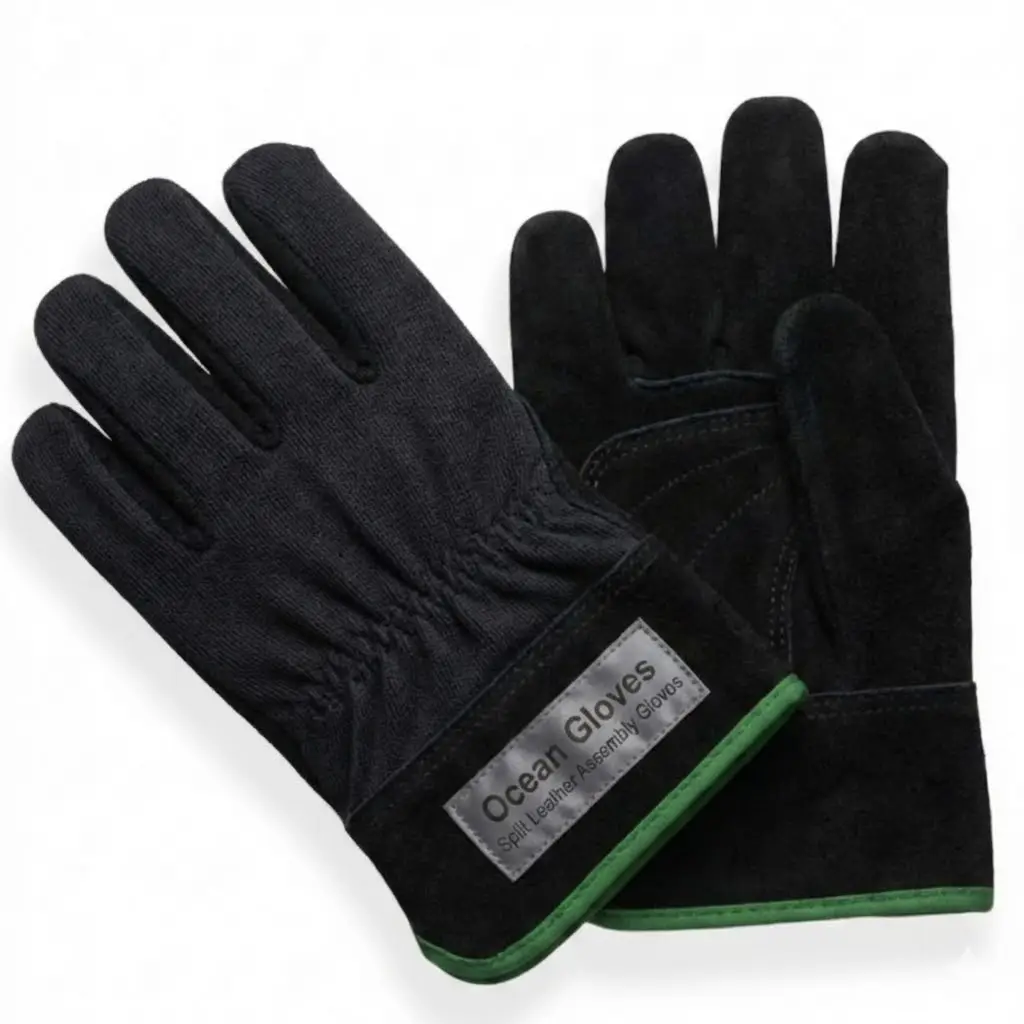
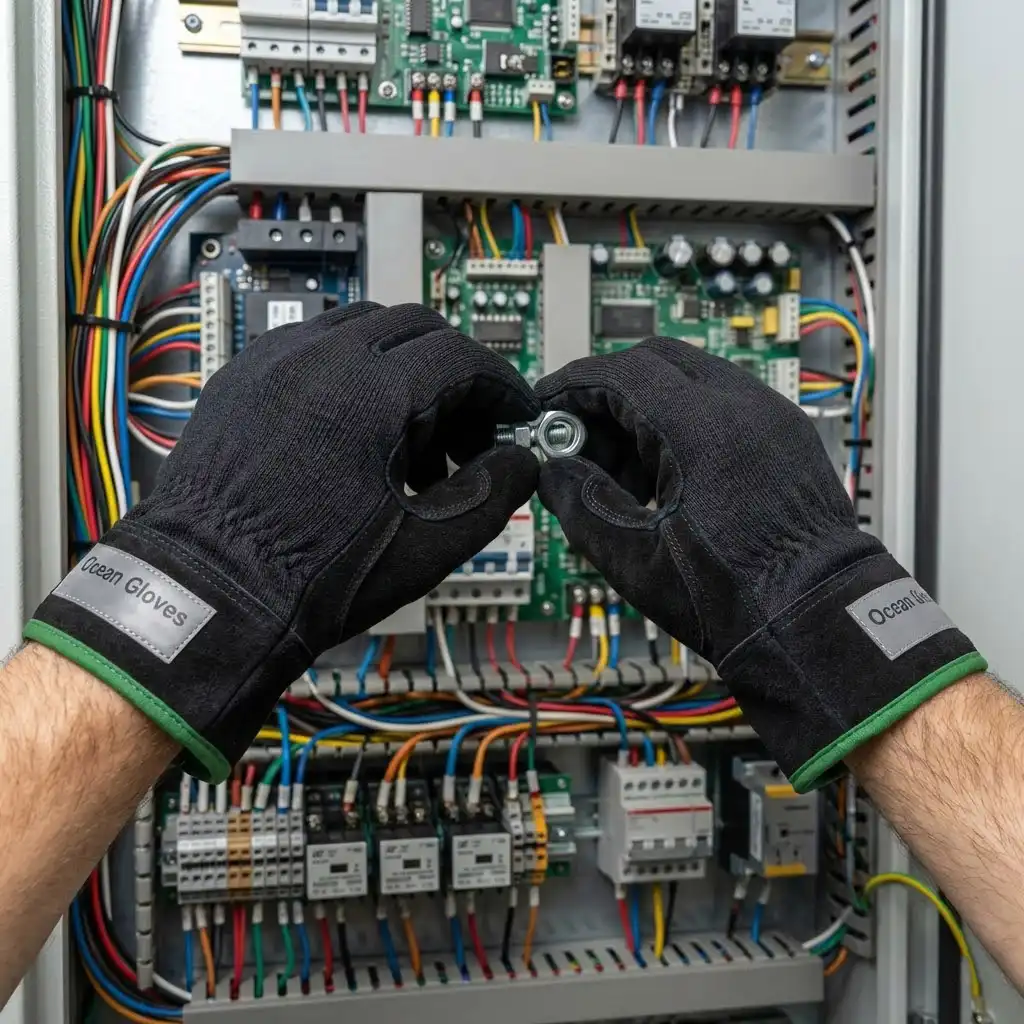
The Engineering Behind Split Leather Assembly Gloves
When we discuss split leather assembly gloves at our factory in Sialkot, we are discussing the most misunderstood category in the PPE industry. Many buyers assume that “split” implies a lack of quality. This is scientifically incorrect. The split is simply the corium layer of the hide, which sits beneath the grain. This fibrous network is denser and often provides superior abrasion resistance compared to top grain leather of the same thickness. We engineer these gloves specifically for general assembly split leather gloves applications where grip on rough materials and cost control are the primary variables.
Material Physics: The Corium Advantage of Split Leather Assembly Gloves
The primary material we use is cow split leather palm. Unlike goatskin which relies on tensile strength, cow split relies on fiber density. When we process the hide, the splitting machine separates the top grain from the bottom split. This bottom layer has a rougher surface texture. In physics terms, this increases the coefficient of friction. This is why split leather work gloves are superior for handling slippery cardboard boxes or oily automotive parts assembly. The rough surface acts as a natural brake, reducing the grip force required by the worker and lowering the risk of musculoskeletal fatigue over an eight-hour shift.
We specifically calibrate our splitting machines to produce a consistent thickness between 0.8mm and 1.0mm. If we go thinner, we sacrifice puncture resistance. If we go thicker, we lose the flexibility required for light industrial split gloves. Achieving this balance is the difference between a clumsy welder’s glove and effective split leather work gloves.
The Raw to Box Process of Split Leather Assembly Gloves
Our manufacturing process for split leather assembly gloves Pakistan begins at the tannery level. We do not buy ready-made leather from the open market. We oversee the tanning drums.
Selection: We select cowhides that have minimal scarring on the flesh side.
Splitting: The hide is fed through a band knife splitter. This is a critical step. If the blade oscillates even slightly, you get uneven thickness. We maintain a tolerance of +/- 0.1mm.
Tanning: We use a chromium sulfate process that ensures the fibers remain flexible. We monitor the pH levels strictly to prevent the leather from becoming brittle or acidic, which can cause skin irritation.
Die Cutting: We use hydraulic presses with forged steel dies. This ensures every pair of cow split leather gloves has identical dimensions.
Stitching: We use polyester thread with a lock-stitch pattern. A chain stitch is cheaper but will unravel if a single loop is broken. We do not take that risk.
Analyzing the Backing Materials
For assembly gloves with fabric back, the choice of textile is engineering, not decoration. We typically utilize a polyester fabric back or a cotton blend back. The decision depends on the thermal dynamics required. Polyester offers higher tensile strength and resists shrinking, making it ideal for budget work gloves exporter Pakistan requirements where longevity is key. Cotton offers better moisture wicking. We join the leather palm to the fabric back using a specific inseam stitch that protects the thread from external abrasion. This creates breathable assembly gloves that allow heat to escape from the dorsal side of the hand while the palm protects against mechanical risks.
Cowhide Split Assembly Gloves vs. Grain Leather
Why choose split leather palm gloves over grain leather? It comes down to the cost-to-performance ratio. Grain leather includes the epidermis, which is smooth and water-resistant. However, it is significantly more expensive. For dry environments where water resistance is not required, split leather offers 80 percent of the mechanical protection at 40 percent of the cost. This makes them the ultimate economical assembly gloves for large crews.
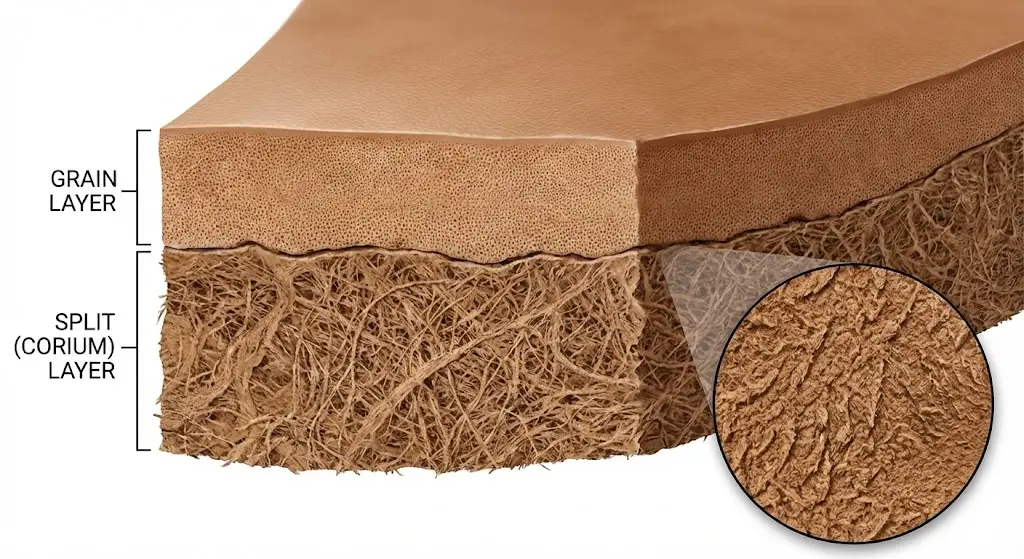
Visual breakdown of cowhide layers showing the Grain vs. Split (Corium) junction, highlighting the rough surface texture of the split layer for grip enhancement.
Technical DNA of Split Leather Assembly Gloves
Below is the technical specification sheet for our standard production run.
| Specification Parameter | Technical Value | Engineering Note |
| Dermis Origin | Bovine (Cow) Corium Layer | High fiber density for abrasion |
| Thickness Calibration | 0.8mm – 1.0mm | Optimized for dexterity/protection balance |
| pH Value | 3.5 – 4.5 | Skin-neutral to prevent dermatitis |
| Chromium VI | < 3 mg/kg | REACH compliant processing |
| Abrasion Cycles | > 500 cycles (EN 388 Level 2) | Tested on Martindale apparatus |
| Tear Strength | > 25 Newtons | Resists tearing during rough handling |
| Backing Material | 100% Cotton or Poly/Cotton | 240 GSM weight for durability |
| Cuff Style | Rubberized or Pasted Safety Cuff | Provides wrist artery protection |
Cost-Effective Split Leather Assembly Gloves Manufacturer Logistics
We position ourselves as a budget work gloves exporter Pakistan not by cutting corners on safety, but by optimizing efficiency. We are a high volume gloves supplier. When you order bulk split leather assembly gloves, we utilize nesting software for our cutting dies. This minimizes leather wastage (off-cuts). Less waste means lower material costs, which we pass on to you. This is how we produce budget-friendly work gloves that still meet European safety standards.
Case Study: Solving the Turnover Crisis
A large logistics handling gloves client in Europe was facing a crisis. They were using expensive synthetic dipped gloves. Their staff turnover was high, and gloves were being lost or discarded before they wore out. They needed a solution that reduced capital expenditure without compromising safety standards.
We analyzed their workflow. It involved handling dry corrugated boxes and wooden pallets. We transitioned them to our affordable split leather assembly gloves. The rough texture of the cow split leather palm provided better grip on cardboard than the smooth nitrile they were using. By switching to our budget assembly gloves, they reduced their annual PPE spend by 35 percent. Furthermore, the workers preferred the breathability of the cotton blend back over the fully coated synthetics. This proves that value for money gloves are an engineering solution, not just a financial one.
The Role of Economical Safety Gloves in Industry
There is a misconception that economical assembly gloves are unsafe. This is false. A glove is only unsafe if it is used for the wrong application. For general maintenance gloves, packaging operations gloves, and light construction, split leather is the gold standard. As a split leather gloves manufacturer Sialkot, we ensure that even our cheapest options undergo rigorous quality control. We inspect the stitching density and the leather grade. Ocean Gloves is the split leather assembly gloves supplier Pakistan that puts engineering first.
We produce cheap assembly gloves for high volume operations, but the word “cheap” refers only to the price point, not the engineering integrity. When you source affordable split leather assembly gloves wholesale Pakistan from Ocean Gloves, you are getting a product that has been engineered to perform.
FAQs
Why do split leather assembly gloves have better abrasion resistance than some synthetics?
The fibrous nature of the corium layer in cow split leather work gloves creates a dense matrix of collagen fibers. When subjected to friction, these fibers compress rather than shred, whereas many synthetic polymers can melt or tear under similar abrasive loads.
How does the thickness of 0.8mm to 1.0mm impact the dexterity of cow split leather gloves?
This gauge is the critical threshold. Below 0.8mm, the split leather lacks the structural integrity to hold stitches under tension. Above 1.0mm, the material becomes too rigid for fine manipulation, making it unsuitable for light industrial split gloves.
What is the chemical difference in tanning for affordable assembly gloves versus premium leather?
For budget assembly gloves, we optimize the tanning drum rotation to maximize dye penetration speed. However, we never compromise on the neutralization phase. If the acid is not neutralized, the leather will decay, regardless of the price point.
Why is cow split leather palm preferred for packaging operations over goatskin?
Goatskin is high in lanolin and smooth, which can be slippery on cardboard. The cow split leather palm has a high coefficient of friction due to its nap (surface texture), providing a mechanical grip advantage for packaging operations gloves.
How do you ensure consistency as a split leather gloves manufacturer Sialkot?
Consistency in split leather comes from the shaving machine. After tanning, we run the hides through a precision shaving machine that levels the thickness across the entire hide, ensuring your batch of split leather work gloves Pakistan is uniform.
Can budget-friendly cow split leather work gloves meet EN 388 standards?
Absolutely. Our cost-effective assembly gloves typically achieve Level 2 or Level 3 in abrasion resistance under EN 388 testing protocols. The cost reduction comes from raw material selection, not a lack of protective performance.
Why do you use a cotton blend back for general assembly split leather gloves?
A cotton blend back provides a specific balance of hygroscopic (moisture-absorbing) properties and tensile strength. Pure polyester traps sweat, while pure cotton can rot. The blend ensures the durability required for economical safety gloves.
What causes the “dust” sometimes found on new economical split leather gloves supplier Sialkot products?
This is buffing dust. To create a uniform nap, the leather is buffed. If not vacuumed properly at the factory, dust remains. Ocean Gloves uses high-suction extraction tables to minimize this, even on our cheap assembly gloves.
Are heavy metals a concern in budget work gloves exporter Pakistan shipments?
We strictly control Chromium VI formation. This is a carcinogenic byproduct that can form if leather is tanned poorly or stored in humid, hot conditions. We use buffering agents to prevent this oxidation, ensuring safety for the wearer.
How does the fiber density of the shoulder split differ from the belly split?
We avoid belly splits for industrial use because the fiber structure is loose and stretches excessively. We use shoulder or side splits for our split leather assembly gloves, as the collagen fibers are tighter and more multidirectional.
Why is the stitch count per inch important for cost-effective split leather assembly gloves manufacturer processes?
A low stitch count leaves gaps that allow dust ingress. A count that is too high perforates the leather, creating a tear strip. We engineer the stitch count based on the specific tensile strength of the leather batch.
Do cowhide split assembly gloves resist oil penetration?
Naturally, split leather is porous. However, because it is the corium layer, it can absorb a significant amount of oil before it penetrates to the skin, unlike grain leather which allows oil to run off onto the work piece.
What is the thermal tolerance of split leather palm gloves?
Leather is a natural insulator. It creates a thermal barrier that synthetics cannot match without melting. This makes these gloves safer for general maintenance gloves where incidental heat contact might occur.
Why are affordable split leather assembly gloves wholesale Pakistan often yellow or grey?
These are standard industry colors. Yellow implies caution and visibility. Grey (natural) hides soil and grease. Dyeing leather dark colors requires more chemical fixation, which adds cost to budget-friendly work gloves.
How does humidity affect the storage of bulk split leather assembly gloves?
Leather is hygroscopic. If stored in high humidity (>70%), it can mold. If stored in low humidity (<30%), it can desiccate and crack. We warehouse our stock in climate-controlled environments before export.
Is there a difference in puncture resistance between split and grain leather?
Yes. Grain leather is generally better for fine puncture (needles). However, due to the density, split leather offers respectable resistance to blunt punctures, such as wood splinters, making them ideal for DIY project gloves.
Why do we use a gunn cut pattern for high volume assembly gloves?
The gunn cut moves the seams to the back of the fingers. This removes the stitching from the primary wear area on the palm side, significantly extending the life of value for money gloves.
Can split leather work gloves be washed?
Technically yes, but we advise against it for split leather. Water removes the fat liquors introduced during tanning, causing the leather to stiffen. Dry cleaning is the only engineering-approved method for leather.
What is the advantage of a rubberized cuff on industrial split leather gloves?
A rubberized safety cuff stays open, allowing airflow and permitting the user to kick the glove off quickly if it gets caught in machinery. This is a critical safety feature for warehouse operations gloves.
Why are your cost-effective assembly gloves considered “eco-friendly” compared to nitrile?
Leather is a byproduct of the meat industry. It is a repurposed biological material. Unlike nitrile or PU gloves which are petrochemical derivatives that persist in landfills for centuries, leather is biodegradable.
WhatsApp us or email Sales@oceangloves.com
Facebook | Twitter | Instagram | YouTube | LinkedIn