


The Engineering Behind Cowhide Assembly Gloves
Understanding the Material Physics of Cowhide Assembly Gloves
When we engineer cowhide assembly gloves, we are dealing with a material that is fundamentally different from goatskin or sheepskin. Cowhide is the standard for heavy duty assembly gloves because of its dense fiber structure. The collagen fibers in cowhide are woven tightly in a cross-pattern which gives the leather significant tensile strength and resistance to abrasion. This is why we recommend cowhide leather assembly gloves for applications involving rough lumber, concrete, and metal burrs.
In our Sialkot tannery, we select hides that offer a specific thickness range of 1.0mm to 1.2mm. This thickness is critical. If the leather is too thin, it fails under the stress of heavy lifting. If it is too thick, the worker loses hand mobility. We balance this to create durable cowhide assembly gloves that protect the hand without causing fatigue. Unlike synthetic alternatives, cow leather assembly gloves conform to the hand over time due to body heat, creating a custom fit that improves grip and safety.
The Manufacturing Process of Heavy Duty Cowhide Assembly Gloves
The production of premium cowhide work gloves begins long before the sewing machine. As a cowhide leather gloves manufacturer Sialkot, we start with the raw hide selection. We look for heavy duty leather gloves material that is free from excessive scarring or brand marks which can act as weak points in the structural integrity of the glove.
Once the leather is tanned and processed to the correct pH balance to prevent skin irritation, it moves to the cutting floor. Here, we use hydraulic press cutters to stamp out the palm patterns. We ensure that the palm is cut from the side or shoulder of the hide where the fiber density is highest. The belly leather is often too stretchy and weak for industrial cowhide gloves, so we discard it for lower-grade products or other industries.
The assembly process involves stitching the leather palm to the Trinda fabric back. We use the industrial cowhide assembly gloves with fabric back design to manage thermal regulation. Full leather gloves can cause hands to sweat excessively in warm environments. The Trinda fabric provides necessary ventilation while the leather stays where the protection is needed. We use double stitching in high-stress areas like the thumb crotch and fingertips to ensure the seams last as long as the leather itself.
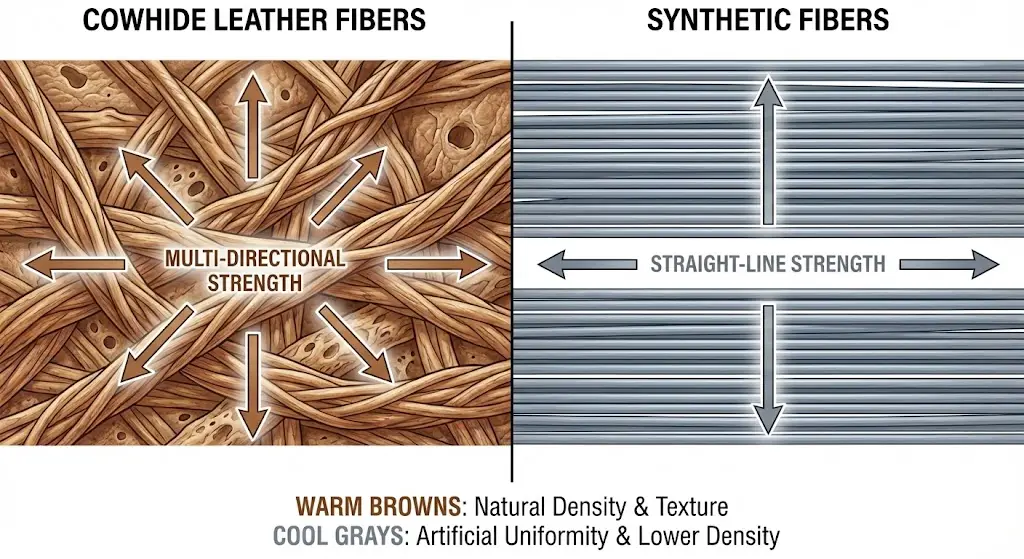
Visual diagram showing the cross-section of cowhide leather fibers compared to synthetic fibers, highlighting the density and multi-directional strength
Technical Specifications and Performance Data of Cowhide Assembly Gloves
We believe in transparency regarding our materials. Below is the technical DNA of our cowhide work gloves.
| Specification Feature | Technical Value | Engineering Impact |
| Leather Material | Full-Grain Cowhide | Maximum abrasion resistance and durability |
| Thickness | 1.0mm – 1.2mm | Optimal balance of protection and flexibility |
| Back Material | Trinda Fabric | Breathable moisture management |
| Construction Style | Gunn Cut | Removes seams from the wear area on the palm |
| Primary Hazard Protection | Mechanical (Abrasion/Cut) | Resists rough surfaces and sharp edges |
| Cuff Style | Safety Cuff / Elastic | wrist protection and easy donning |
| Origin | Sialkot, Pakistan | Utilizing generations of tanning expertise |
Applications in Heavy Industry and Construction
We manufacture heavy-duty cowhide leather assembly gloves for industrial use where the environment is unforgiving. In the construction sector, workers handle rebar, concrete blocks, and lumber daily. A standard assembly glove would disintegrate after a few days of this friction. Our cowhide palm assembly gloves provide the barrier needed to handle these abrasive materials without wearing through to the skin.
For metalworking and steel handling gloves applications, the thickness of the cowhide provides a buffer against sharp edges and burrs. While they are not dedicated cut-proof gloves like those with Kevlar liners, the natural density of the cow leather assembly gloves offers significant cut resistance for general handling. We also supply these as machinery operation gloves where the grip provided by the leather grain helps in controlling heavy levers and tools.
We are also a major premium cowhide leather work gloves for construction supplier. The Trinda fabric back is essential here. On a job site, temperatures can fluctuate. The fabric allows moisture to escape, keeping the hands dry. Wet hands soften the skin and make it more prone to blistering. By keeping the hands dry, our gloves actively contribute to hand health and worker productivity.
Why Sourcing from a Manufacturer in Pakistan Matters
When you buy cowhide assembly gloves Pakistan, you are tapping into a supply chain that has been refined over decades. Sialkot is the world hub for leather goods. As a cowhide work gloves supplier Pakistan, Ocean Gloves Corporation controls the quality from the tannery to the final packaging. We do not rely on third-party inspections because we are the inspectors.
Many importers struggle with consistency when buying from traders. You might get one batch of durable cowhide assembly gloves and the next batch is made from lower-grade split leather. Ocean act as a consistent heavy duty gloves exporter Pakistan because we own the manufacturing process. Ocean can guarantee that the cowhide leather work gloves you order today will match the specifications of the gloves you order next year.
We are also a thick cowhide assembly gloves wholesale supplier for brands that need OEM services. We can stamp your logo on the leather or the fabric back. Our capability to customize size, color, and packaging allows you to build your brand on top of our engineering foundation.
Abrasion Resistance and Durability Factors of Cowhide Assembly Gloves
The primary reason our clients choose thick leather assembly gloves is abrasion resistance. Abrasion is the wearing away of material through friction. In laboratory settings, we test our cowhide against sandpaper under weight to measure how many cycles it takes to break through the material. Cowhide consistently outperforms other leathers in this specific metric.
The durability of abrasion resistant assembly gloves is also dependent on the conditioning of the leather. If the leather is too dry, it cracks. If it is too oily, it becomes soft and loses tensile strength. Our chemical engineers in Sialkot formulate the tanning liquors to ensure the leather remains supple yet tough. This is the difference between a cheap glove and a professional tool.
We also focus on puncture resistance. While no leather is puncture-proof, the fibrous nature of the 1.2mm cowhide in our heavy duty assembly gloves helps deflect splinters and wire ends that would easily penetrate synthetic knits or thinner leathers. This makes them ideal fabrication work gloves where metal shavings are common.
Case Study: Solving Durability Issues for a Steel Plant
A client in the heavy steel fabrication sector approached us with a problem. They were using synthetic coated gloves that were failing after only 8 hours of handling raw steel beams. The sharp edges of the steel were slicing through the nitrile coating, and the rough surface was wearing down the liner. They needed a solution that was cost-effective but durable.
We analyzed their workflow and recommended our heavy industrial assembly gloves made from cowhide. We supplied them with a sample run of our cowhide assembly gloves with Trinda fabric back. The switch to leather provided immediate results. The natural fiber structure of the cowhide absorbed the abrasion from the steel beams without failing. The lifespan of a single pair of gloves went from 8 hours to over a week of heavy use.
By switching to our durable cowhide assembly gloves manufacturer Pakistan solution, the client reduced their monthly glove expenditure by 40 percent. They also reported fewer minor hand injuries because the leather provided better protection against the metal burrs. This proves that for certain applications, natural cow leather assembly gloves remain superior to modern synthetics.
Comparing Cowhide to Other Leather Types
It is important to understand why we choose cowhide for this specific category. Goatskin is excellent for dexterity and tactile sensitivity, making it great for precision assembly. However, goatskin is thinner and less resistant to heavy abrasion. Sheepskin is soft and comfortable but lacks the durability for heavy construction.
Cowhide work gloves sit at the top of the hierarchy for durability. The hide is naturally thicker and the fibers are coarser. This makes the glove slightly stiffer initially, but significantly stronger. For tasks requiring fine motor skills, we would recommend our goatskin line. But for moving bricks, welding steel, or clearing debris, our cowhide leather assembly gloves are the only logical engineering choice.
We also distinguish between full-grain and split leather. Our Cowhide assembly gloves focuses on the quality of the hide. While we do offer split leather options for budget-conscious buyers, these premium cowhide work gloves utilize the strength of the grain. The grain layer is the strongest part of the hide. By keeping this intact, we maximize the tear strength and longevity of the glove.
Logistics and Supply Chain Reliability
As a cowhide leather gloves manufacturer Sialkot, we understand that our product is a consumable item for your business. You cannot afford to run out of stock. We maintain a steady supply of raw hides to ensure that our production lines never stop. Whether you are ordering a single pallet or a container load, our logistics team ensures that your heavy duty cowhide gloves arrive on schedule.
We handle all the export documentation. When you work with a heavy duty gloves exporter Pakistan like Ocean Gloves, you are not just buying a product; you are buying a seamless supply chain solution. We are the industrial cowhide assembly gloves with fabric back experts, and we are ready to support your operations with reliable, high-quality safety equipment.
FAQs
Why do you recommend cowhide assembly gloves specifically for handling concrete and lumber?
Cowhide has a dense, cross-linked fiber structure that provides superior resistance to abrasion. Concrete and rough lumber act like sandpaper; softer leathers like sheepskin would wear through quickly. The 1.0-1.2mm thickness of our cowhide acts as a sacrificial layer that protects the skin from this constant friction.
What is the functional difference between cowhide and buffalo leather in industrial applications?
While both are durable, cowhide generally offers a smoother grain surface and better flexibility after tanning. Buffalo leather can be more porous and stiffer. For our cowhide leather assembly gloves, we prioritize the balance between the extreme durability needed for industry and the flexibility required for tool manipulation.
How does the Trinda fabric back influence the mechanical testing results of the glove?
The Trinda fabric back improves the comfort and breathability but does not offer the same mechanical protection as the leather palm. Therefore, when we test industrial cowhide assembly gloves with fabric back, the high EN 388 ratings for abrasion and puncture apply specifically to the palm area where the work is performed.
Why is the thickness of 1.0mm to 1.2mm considered the engineering standard for heavy duty assembly gloves?
This gauge provides the optimal intersection of protection and ergonomics. Leather thinner than 1.0mm lacks the structural integrity to resist heavy abrasion forces. Leather thicker than 1.2mm creates resistance against the closing of the hand, leading to rapid muscle fatigue in the user’s grip.
Does the chromium content in the tanning process affect the user’s skin?
Yes, improper tanning can leave free chromium VI, which is a skin irritant. As a responsible cowhide leather gloves manufacturer Sialkot, we strictly control our tanning process to ensure all leather is REACH compliant. We fix the chromium salts into the collagen structure so they do not leach out onto the worker’s hand.
Can these gloves be used for welding applications alongside assembly?
Cowhide is naturally heat resistant and resists sparks better than synthetics. While these are primarily cow leather assembly gloves, the heavy duty nature of the leather allows them to be used for light spot welding or tacking during fabrication work gloves scenarios, though they are not fully lined welder’s gauntlets.
What is the advantage of the Gunn cut pattern used in your cowhide work gloves?
The Gunn cut moves the seams to the back of the fingers. In heavy handling, the palm side of the fingers is under constant pressure. If seams were placed there, the thread would abrade and snap. By moving the structural weak points away from the wear zone, we extend the life of the glove.
How does moisture impact the lifespan of cowhide leather work gloves?
Leather is skin; repeated cycles of soaking and drying can wash out the natural oils, causing the leather to stiffen and crack. While our cowhide is treated for durability, we recommend storing them in dry conditions. For wet environments, we would recommend looking at our waterproof specific lines, though cowhide handles incidental moisture well.
Why do you use full-grain leather instead of split leather for this specific product?
Split leather is the bottom layer of the hide and lacks the tight grain surface. Full-grain leather retains the epidermis layer, which provides the highest tensile strength and water resistance. For premium cowhide work gloves, full-grain is necessary to achieve the durability required for heavy construction and metalworking.
How do you ensure consistency in leather thickness across large orders?
We use precise splitting machines in our Sialkot facility. Every hide is passed through a band knife splitter that levels the leather to the exact 1.0-1.2mm specification. This ensures that a glove from the first box of an order feels identical to a glove from the last box.
Are there specific storage requirements for bulk orders of cowhide assembly gloves?
Leather is organic. It should be stored in a cool, dry place away from direct sunlight. UV rays can degrade the leather over time, and high humidity can promote mold. As a durable cowhide assembly gloves manufacturer Pakistan, we package our goods to withstand shipping, but warehouse storage conditions matter for long-term shelf life.
What makes Trinda fabric the preferred choice for the back of these gloves?
Trinda is a warp-knitted polyester fabric that is robust yet breathable. Unlike simple cotton jersey, Trinda has higher tear resistance. This is crucial for heavy duty assembly gloves because the back of the hand can still snag on machinery or materials, and the fabric needs to hold together.
How does the pH level of the leather affect the durability of the stitching?
If the leather is too acidic (low pH), it can degrade the cotton or polyester thread used for stitching over time, causing the glove to fall apart even if the leather is intact. We monitor the pH of our cowhide leather assembly gloves to ensure it is neutral, preserving the integrity of the seams.
Why are these gloves preferred for steel handling over synthetic coated gloves?
Steel beams often have sharp burrs and rough scale. This texture acts like a cheese grater on nitrile or PU coatings, stripping them away rapidly. The fibrous network of cowhide leather assembly gloves absorbs this abuse without immediate failure, providing a safer and more economical solution for steel handling.
What is the difference in abrasion resistance between the shoulder and belly sections of the hide?
The shoulder area has a much tighter fiber weave due to the animal’s movement. The belly is loose and stretchy. We strictly use the tighter grain sections for our industrial cowhide gloves to ensure that the abrasion resistance is uniform across the palm. Belly leather is never used in our heavy-duty lines.
How do you test for puncture resistance in the factory?
We use a standardized stylus that is pushed through the leather at a set speed, measuring the force in Newtons required to penetrate. This ensures our heavy duty cowhide gloves meet the EN 388 standards required for industrial safety, protecting workers from nails, wire, and splinters.
Can these gloves be customized with impact protection for mining applications?
Yes. While Cowhide assembly gloves is a standard assembly glove, as a manufacturing partner, we can modify the design to add TPR (Thermo Plastic Rubber) backing. However, for standard heavy duty cowhide leather assembly gloves for industrial use, the current design offers the best balance of cost and protection.
Why is the thumb geometry critical in assembly gloves?
The thumb opposes the fingers and is involved in almost every grip action. We use a wing thumb or keystone thumb design in our premium cowhide leather work gloves for construction to allow for natural movement. Poor thumb design creates tension in the web of the hand, leading to hand fatigue after a few hours of work.
Do these gloves offer any protection against vibration?
The thickness of the leather and the natural density of cowhide provide some dampening of high-frequency vibrations from power tools. However, they are not certified anti-vibration gloves. They are durable cowhide assembly gloves designed primarily for material handling and abrasion protection.
How does the cost-per-wear of cowhide compare to cheaper split leather options?
While the initial investment in premium cowhide work gloves is higher, the longevity is significantly greater. A split leather glove might last 2 days in a metal fabrication shop, while our full-grain cowhide glove could last 10 days. The cost-per-hour of protection is significantly lower with high-quality cowhide.
WhatsApp us or email Sales@oceangloves.com
Facebook | Twitter | Instagram | YouTube | LinkedIn