

The Engineering Behind Synthetic Leather Assembly Gloves
When we discuss synthetic leather assembly gloves at the factory level, we are discussing the physics of friction and the chemistry of polymers. Many buyers assume synthetic means “cheap” or “inferior.” That is a misconception from the 1990s. Today, our synthetic assembly gloves are engineered substrates designed to outperform natural leather in specific metrics like abrasion resistance consistency and caliper uniformity. At Ocean Gloves Corporation, we treat the manufacturing of these gloves not as a craft, but as a science.
The Material Physics of Armor Skin™ Synthetic Leather Assembly Gloves vs Natural Hide
The primary failure point in most budget work gloves is the inconsistency of the palm material. Natural leather varies in thickness and tensile strength depending on where it was cut from the animal. Our synthetic work gloves utilize Armor Skin™, a proprietary polyurethane (PU) composite. This material is created by layering a porous polyurethane coating over a microfiber base.
This structure is critical for two reasons. First, the microfiber base provides the tensile strength and tear resistance required for industrial handling gloves. Second, the PU coating provides the grip coefficient. Unlike natural leather, which can become slick when saturated with oil or water, the surface tension of our PU leather assembly gloves is chemically engineered to maintain grip in slick conditions. This makes them superior for light duty assembly tasks where dropping a component is not an option.
Furthermore, because we are a vegan work gloves supplier Pakistan, we ensure that the entire lamination process is free from animal by-products. This allows you to market these gloves to corporations with strict sustainability and ethical procurement mandates.
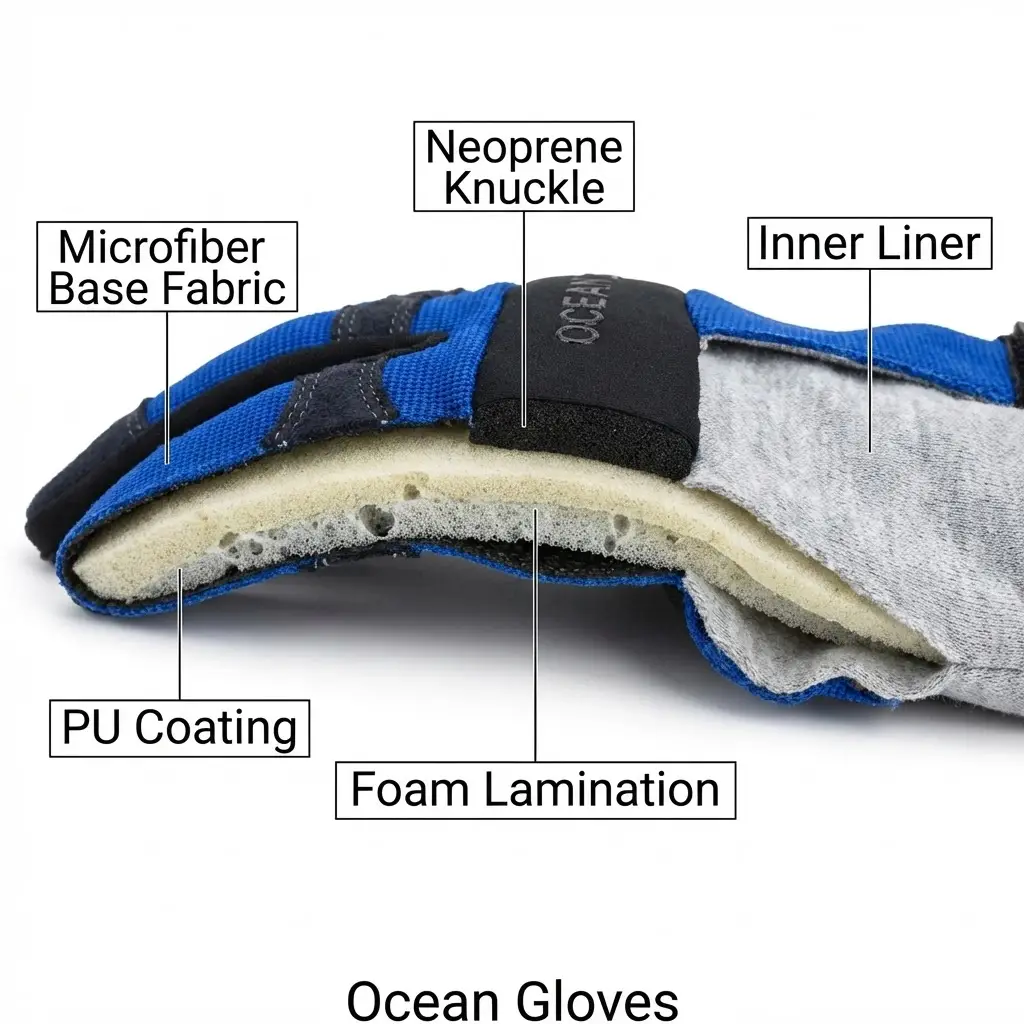
Visual breakdown of the glove layers showing the Microfiber Base, PU Coating, Foam Lamination, and the Neoprene Knuckle Guard cross-section
The “Raw to Box” Manufacturing Process of Synthetic Leather Assembly Gloves
Our manufacturing line for these gloves differs significantly from our leather lines. It starts with the die-cutting of the Armor Skin™ sheets. Because the material is uniform, we can nest the dies closer together, reducing waste. This efficiency is why we can offer affordable synthetic leather assembly gloves for light duty work without compromising on stitch quality.
Once the palms are cut, we prepare the back of the hand. We use a breathable knit fabric rather than a solid sheet. This is crucial for reducing thermal load. In a warehouse environment, a worker’s hand can perspire up to 5 milliliters per hour. Solid backs trap this moisture, leading to dermatitis and discomfort. Our knit back allows for rapid evaporation.
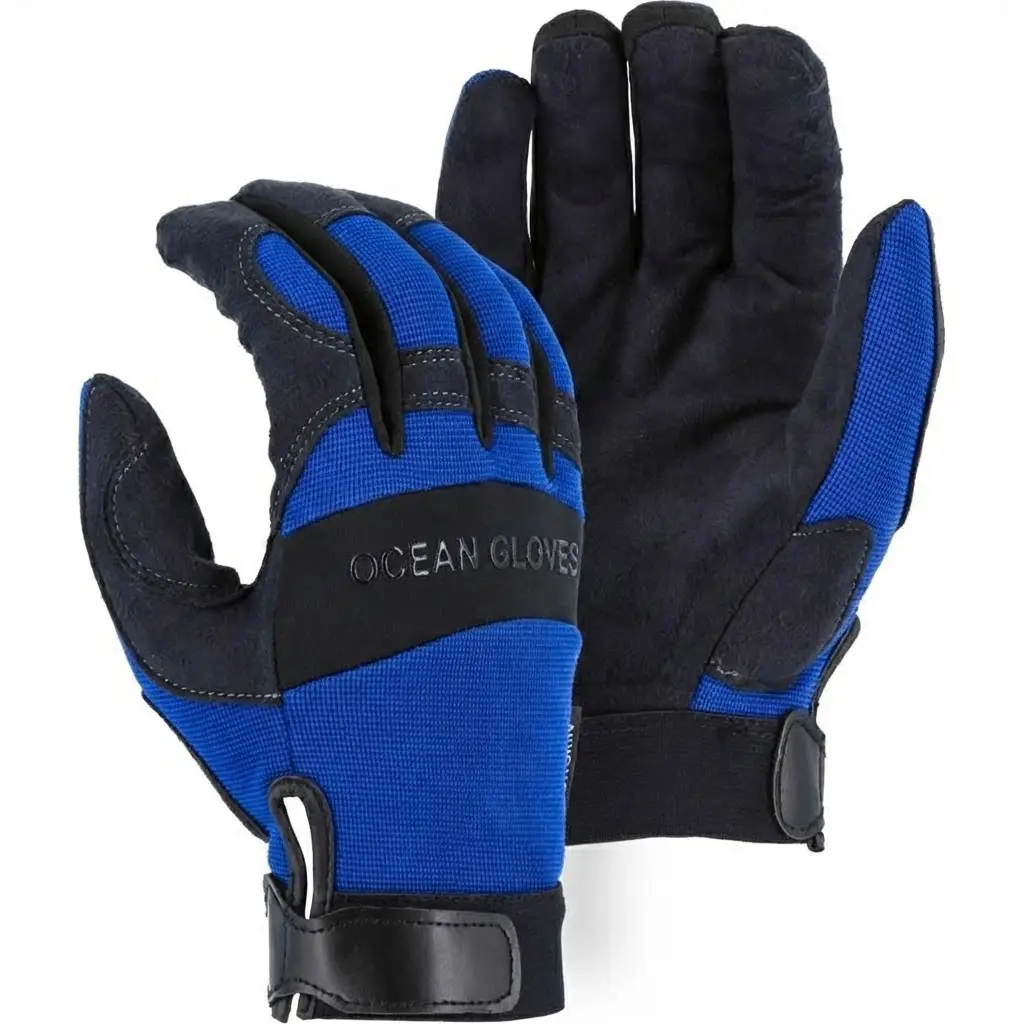
We then integrate the neoprene knuckle protection. This involves stitching a 2mm to 3mm neoprene strip across the metacarpal ridge. This absorbs impact energy during warehouse synthetic gloves operations, such as reaching into bins or shelves. The final assembly involves the attachment of the adjustable velcro wrist. We use a high-cycle hook and loop fastener that resists clogging with dust, ensuring the glove stays secure over months of use.
Ergonomics and Hand Fatigue Reduction
The hidden cost of cheap gloves is Hand-Arm Vibration (HAV) and general fatigue. While these are not anti-vibration gloves, the design focuses on reducing static load. We cut the synthetic palm assembly gloves patterns with pre-curved fingers. Most human hands rest in a semi-closed position, not flat. If a glove is cut flat, the worker must exert constant muscle energy just to close their hand around a tool.
By pre-curving the fingers, we reduce the joules of energy required for grip actuation. Over an 8-hour shift involving thousands of grasp-and-release cycles, this significantly lowers the risk of Repetitive Strain Injury (RSI). This ergonomic focus is what makes us a preferred synthetic leather gloves manufacturer Sialkot for European and North American markets.
Technical DNA: Synthetic Leather Assembly Gloves vs. Split Leather
We often get asked to compare our synthetic options against traditional split leather. Here is the technical breakdown based on our internal lab testing.
| Feature Spec | Armor Skin™ Synthetic Assembly Gloves | Traditional Cow Split Leather Gloves |
| Caliper Consistency | 100% Uniform (0.05mm variance) | High Variance (up to 0.4mm variance) |
| Abrasion Resistance | High (Engineered Polymer) | Medium (Fibrous structure) |
| Breathability | High (Knit Back) | Low (Solid Leather/Canvas) |
| Washability | Excellent (Does not stiffen) | Poor (Stiffens after drying) |
| Chromium VI Content | Zero (0 ppm) | Risk of presence if untanned properly |
| Tactile Sensitivity | High (Microfiber base) | Low (Thick leather) |
| Cost Stability | Stable (Petroleum based) | Volatile (Livestock market based) |
Strategic Applications in Industry
We design these specifically as general work synthetic gloves. They excel in environments where dexterity is more valuable than heat resistance. For example, in automotive electronics assembly, the worker needs to feel the snap-fit of a connector. A thick cowhide glove dulls this feedback. Our PU leather work gloves transmit that tactile click while protecting the skin from sharp plastic edges.
For material handling synthetic applications, such as box moving in logistics centers, the grip provided by the PU coating reduces the grip force required to lift a cardboard box. This coefficient of friction is a key safety feature that prevents dropped loads. Additionally, for companies looking for eco-friendly assembly gloves, the synthetic nature of the product means a lower carbon footprint in the tanning phase compared to chrome-tanned leathers.
Why Sialkot Manufacturing Matters
You might find budget synthetic assembly gloves from other regions, but sourcing from Sialkot offers a distinct advantage in stitching quality. Our workforce is multigenerational, trained originally on high-end leather sporting goods. We apply those same rigorous stitching standards to our synthetic lines.
We use nylon 66 thread for all structural seams, which has a higher melting point and tensile strength than standard polyester threads used by competitors. As a cost-effective PU leather assembly gloves Sialkot producer, we combine this high-end craftsmanship with the efficiency of modern synthetic materials. This results in a glove that lasts longer, effectively lowering your cost-per-pair over the fiscal year.
Reducing Waste for a Packaging Facility
A large packaging facility in the UK was using standard cotton-dotted gloves. They were going through 3 pairs per worker, per week, because the cotton would fray and the dots would peel off. They approached us looking for a budget synthetic leather work gloves wholesale supplier who could solve this durability issue.
We transitioned them to our Synthetic Leather Assembly Gloves Armor Skin™ model. The initial unit cost was 15 percent higher than the cotton glove. However, the lifespan of our synthetic glove was 4 weeks compared to 1.5 days for the cotton glove. The breathable knit back also reduced worker complaints regarding sweat. By the end of the first quarter, the client had reduced their overall glove expenditure by 40 percent and reduced landfill waste volume by 70 percent. This proves that investing in a properly engineered synthetic assembly glove is the smarter financial decision.
Sustainability and the Vegan Advantage
The market demand for vegan friendly gloves is growing. Many multinational corporations now have procurement policies that favor animal-free products. Our animal-free work gloves allow you to bid on these contracts with confidence. Because we control the supply chain, we can issue certificates of origin confirming that no animal products were used in the sizing, glue, or substrate of these gloves. This makes us a reliable vegan work gloves supplier Pakistan for distributors servicing ethical supply chains.
FAQs
Why should we choose a vegan-friendly synthetic assembly glove manufacturer in Pakistan over China?
The difference lies in the stitching architecture. While the base material might be similar, our factory in Sialkot utilizes lock-stitch machinery and high-tensile nylon thread typically reserved for leather production. This means the seams on our synthetic gloves rarely fail before the palm wears out, whereas mass-produced alternatives often suffer from seam bursting.
How does the abrasion resistance of PU leather assembly gloves compare to goatskin?
In standard Martindale abrasion tests, our Armor Skin™ PU leather often outperforms standard grade goatskin. Natural leather has fiber inconsistencies that create weak points. Our engineered PU surface is uniform, meaning the abrasion resistance is consistent across the entire palm surface, offering predictable wear cycles.
Can we wash these eco-friendly synthetic assembly gloves with breathable backs?
Yes, this is a major engineering advantage over leather. Synthetic fibers do not contain protein structures that denature and harden when wet. You can machine wash these gloves at low temperatures to remove oil and grime, and they will retain their flexibility upon drying, significantly extending the product’s lifecycle.
Are these budget synthetic leather work gloves conductive or anti-static?
Standard PU leather is insulative. However, if your environment requires ESD (Electrostatic Discharge) protection, we must add conductive carbon filaments to the knit back and use a specific conductive palm coating. You must specify this requirement in your tech pack so we can adjust the polymer formulation.
Why do you use Neoprene for the knuckle protection instead of TPR?
For light duty assembly and packaging, Thermal Plastic Rubber (TPR) adds unnecessary weight and stiffness. Neoprene provides sufficient impact attenuation for minor bumps and scrapes (like hitting a shelf edge) while maintaining the flexibility required for fast-paced hand movements. It keeps the glove lightweight and reduces hand fatigue.
What is the temperature limit for these synthetic assembly gloves?
Polyurethane coatings begin to soften at temperatures above 80°C (176°F). These are not heat-resistant gloves. If your application involves handling hot automotive parts or fresh welds, you should opt for our leather or Kevlar-lined options. These are designed strictly for mechanical protection at ambient temperatures.
How do cost-effective PU leather assembly gloves Sialkot production reduce material waste?
Because synthetic leather comes in uniform rolls rather than irregular animal hides, our cutting efficiency approaches 95 percent. We use computer-nested die cutting. This lack of waste lowers the raw material cost per unit, allowing us to pass those savings on to you while maintaining high construction quality.
Do these gloves offer any puncture resistance?
The puncture resistance of synthetic leather is lower than that of split cowhide. While the microfiber base prevents snagging, these gloves are not designed to stop needles, nails, or sharp metal burrs. They are engineered for friction and abrasion protection, not puncture prevention.
Why is the “breathable knit back” specified in your specs?
The knit back is usually a polyester-spandex blend. We specify this to ensure a snug fit that moves with the hand. A loose glove compromises safety by creating snag hazards. The knit construction allows for heat dissipation, keeping the hand temperature lower, which directly correlates to improved grip retention as palms sweat less.
Is the velcro closure necessary for light duty assembly?
Yes. In an industrial setting, a slip-on cuff can become loose over time as the elastic degrades. An adjustable velcro wrist allows the user to re-tension the cuff throughout the day. This prevents debris from entering the glove and ensures the glove does not slide off during a high-velocity arm movement.
How do you ensure consistency as a PU leather gloves exporter Pakistan?
We test every batch of synthetic leather roll for thickness and tensile strength before it enters the cutting room. If a roll varies by more than 0.05mm, it is rejected. This rigorous incoming Quality Control (IQC) ensures that the 10,000th pair you receive feels exactly like the sample you approved.
Can these gloves be used for food handling?
No. While the materials are synthetic, this specific glove is not certified for direct food contact. The knit back can trap food particles and bacteria. For food processing, we manufacture specific nitrile or vinyl gloves that meet FDA and EU food safety standards.
What is the chemical resistance profile of the synthetic palm?
PU generally resists oils and light greases better than water. It is stable against weak acids and bases. However, strong solvents like acetone or thinners can dissolve the PU coating over time. For heavy chemical exposure, a full-dip nitrile glove would be the correct engineering choice.
How does the “Pre-curved fingers” feature work in manufacturing?
We sew the fourchettes (the material between the fingers) at a specific tension and angle relative to the palm and back pieces. This forces the glove to naturally rest in a curled position. This matches the neutral posture of the human hand, reducing the flexor muscle engagement required to maintain a working grip.
Are these considered “winter” gloves?
No. These are single-layer unlined gloves. The breathable back is designed to cool the hand, not warm it. Using these in sub-zero temperatures would result in rapid heat loss. For cold environments, we recommend our Thinsulate™ lined Winter Assembly series.
Why do you call them “Armor Skin™”?
Armor Skin™ is the trade name for the specific high-performance synthetic composite we use. It is distinguished from generic “PU leather” by its microfiber backing, which provides superior tear strength. Generic PU is often just a coating on a weak fabric; Armor Skin™ is a structural composite.
Does the synthetic material stretch over time?
Unlike natural leather which can stretch significantly and become loose, synthetic leather has excellent dimensional stability. The glove will maintain its size and fit profile for its entire lifespan, ensuring that safety and dexterity are not compromised as the glove ages.
Can we get affordable synthetic leather assembly gloves for light duty work with our logo?
Yes. Synthetic leather takes ink and heat transfer printing very well. We can silk screen or heat transfer your brand logo onto the back of the hand or the velcro strap. The surface smoothness ensures a crisp, high-resolution logo application that looks professional.
What is the shelf life of these synthetic gloves?
PU coatings are stable, but they can degrade if exposed to high UV or extreme humidity for years in storage (hydrolysis). However, under normal warehouse conditions, they have a shelf life of 3-5 years, which is significantly longer than latex-coated gloves which can become brittle.
Is the neoprene knuckle protection cut-resistant?
Neoprene offers impact buffering, not cut resistance. If a knife slices across the knuckle, the neoprene will cut. Its function is to absorb the energy of a blunt force impact, preventing bruising and bone injury during reaching tasks in tight spaces.
WhatsApp us or email Sales@oceangloves.com
Facebook | Twitter | Instagram | YouTube | LinkedIn