

If you are a buying manager, you have probably felt the frustration. You buy a thousand pairs of “Industrial Grade” leather gloves. Two weeks later, the stitching is popping, the leather is getting stiff, and your team is complaining about hand pain.
The problem usually isn’t the worker. It is the spec sheet.
Most suppliers, especially traders, will tell you generic facts like “Goatskin is soft” or “Cowhide is tough.” That is sales talk, not engineering. As a manufacturer based in Sialkot, we see the tiny differences that determine whether a glove lasts 3 days or 3 months.
This guide is the “Missing Manual” for Leather Assembly Gloves. We are going to look at the physics of the hide, the chemistry of the tan, and the geometry of the stitch.
The Quick Selection Guide
Find your application below.
| Your Application | Best Leather | Ideal Thickness | Thumb Style | Ocean Recommendation |
| Precision Assembly (Electronics, Small Parts) | Goatskin (Strong Pull) | 0.8mm | Keystone | Goatskin Assembly (OC-LAG-101) |
| Heavy Construction (Lumber, Brick, Steel) | Cowhide (Anti-Rub) | 1.0mm – 1.2mm | Wing | Cowhide Assembly (OC-LAG-106) |
| Logistics/Forklift (General Handling) | Hybrid (Fabric Back) | 0.9mm Palm | Keystone | Fabric Back Assembly (OC-LAG-109) |
| Rigging/Oil & Gas (Heavy Machinery) | Goat or Cow | 1.0mm + Liner | Safety Cuff | Canadian Rigger (OC-LAG-117) |
| Cold Storage (Freezers < -10°C) | Goatskin ( Stays Soft) | Insulated | Keystone | Extreme Cold Freezer (OC-LAG-103) |
1. The Physics of Dexterity: Why “Thicker” Isn’t Always Stronger
There is a big misunderstanding in our industry that thicker leather equals safer leather. That is only true if you are comparing the same animal. But when you compare different species, the physics change.
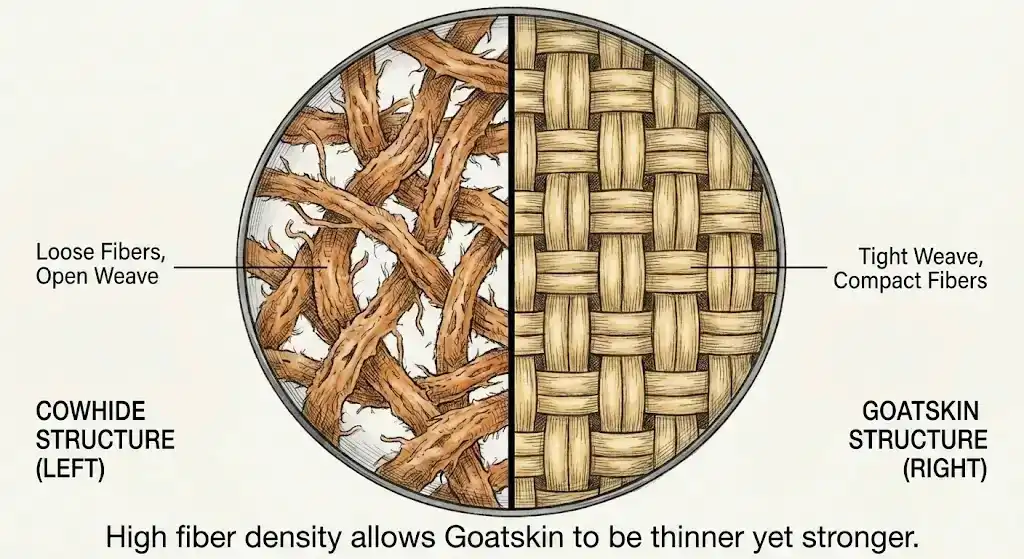
The Fiber Structure Reality
Cowhide (The Sponge): Cow fibers are loose and hairy. To get strength, you need bulk (1.2mm). It is great for abrasion (rubbing against concrete), but terrible for fine movement.
Goatskin (The Chain Link): Goatskin has a tightly woven fiber structure. It is stronger per millimeter than cowhide.
The Ocean Standard:
We laser-gauge our Premium Goatskin Gloves (OC-LAG-101) to exactly 0.8mm.
Why? Because at 0.8mm, Goatskin provides the same strength as 1.1mm Cowhide, but with 30% less bulk. This allows your workers to pick up a washer or feel a trigger without removing their gloves. That is the #1 cause of hand injuries.
2. Thumb Architecture: Stopping the “Web Tear”
Have you ever noticed cheap gloves ripping right between the thumb and the index finger? That is a design failure called “Web Tear.” It happens when you use the wrong thumb style.
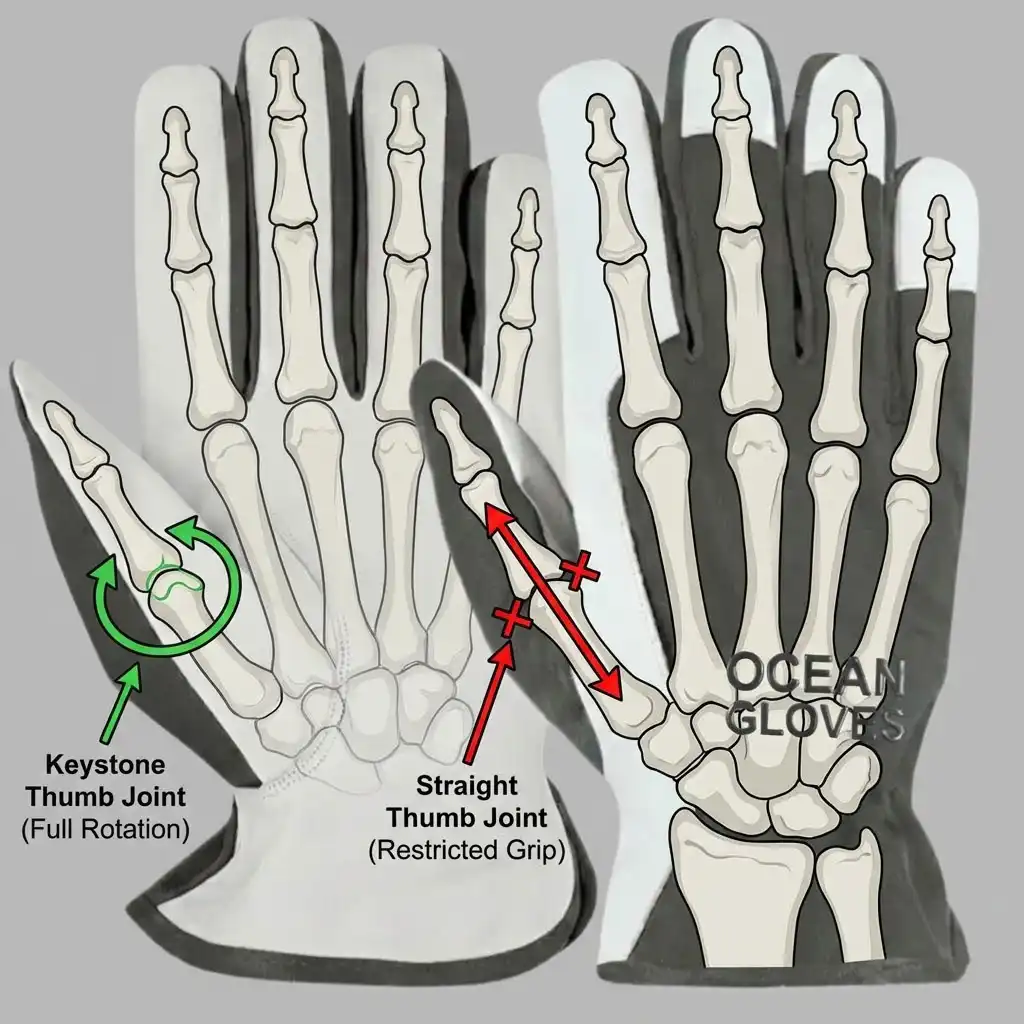
The 3 Thumb Types (And Why We Choose Keystone)
Straight Thumb: The thumb is cut as part of the palm. It is cheap to make, but it stops movement. It forces the leather to bunch up when you grip a tool.
Wing Thumb: The thumb is angled diagonally. Better, but it still pulls on the palm during wide grips.
Keystone Thumb (The Winner): This is a separate piece of leather set into the glove at a 90-degree angle. It copies how your hand works.
Our Approach:
We use the Keystone Thumb on our Driver Assembly Gloves (OC-LAG-116). It offers full range of motion. It costs more to sew, but it prevents hand pain and removes the stress point that causes Web Tear.
3. The Hidden Spec: Chemical Safety (pH & Smell)
Let’s talk about the smell. You know that strong, chemical, “fishy” smell some imported leather gloves have?
That is not “Natural Leather.”
That smell is usually cheap fish oil used in the softening process, or worse, leftover chemicals.
The pH Danger Zone
Human skin has a pH of roughly 5.5. If a tannery rushes the process, the leather can remain acidic (pH 3.0 or lower). When your worker sweats, that acid comes out.
Result: Contact Dermatitis (red, itchy, raw skin).
The Myth: “I’m allergic to leather.”
The Truth: You aren’t allergic to leather; you are reacting to acidic chemicals.
At Ocean Gloves, our leather is REACH Compliant. We maintain a pH balance of 3.5 – 4.0, ensuring it is safe for human skin. We are also Chromium-VI Free (a known carcinogen strictly regulated in the EU).
4. Cuff Selection Guide: Safety vs. Comfort
The cuff isn’t just for looks. It is a key safety feature.
| Cuff Style | What It Is | Best For |
| Slip-On / Open Cuff | No restriction. Easy on/off. | Drivers & Inspectors. Great for on-and-off use. |
| Knit Wrist | Elastic fabric that hugs the wrist. | Dirt Control. Keeps sawdust and dirt out of the glove. |
| Safety Cuff (Rubberized) | A stiff, wide cuff that stays open. | Heavy Machinery. Designed to be thrown off quickly if the glove gets caught in gears or drills. |
Need Heavy Machinery Safety? Use the Canadian Rigger (OC-LAG-117) with a rubberized safety cuff.
Need Comfort? Use the Assembly Glove with Fabric Back (OC-LAG-109) with a slip-on or velcro fit.
5. Weather Protection: Winter & Wet
Leather is skin. And just like your skin, leather freezes in the winter and soaks up water. Standard leather gloves are not waterproof and not warm.
The “Cold Chain” Solution
For freezer work or winter construction, we don’t just add fleece. We engineer layers.
The Shell: Goatskin (remains soft even at -10°C).
The Core: 3M Thinsulate™ C100 (traps heat without bulk).
The Barrier: A Hydro-Guard membrane (stops water, lets sweat steam out).
If you are working in deep freeze (-25°C), standard cowhide will turn into a brick. You need the Extreme Cold Freezer Glove (OC-LAG-103).
6. Glossary of Manufacturing Terms (FAQ)
Q: Can I wash my leather assembly gloves?
A: Be careful. Leather has a protein bond. If you wash it and then dry it with high heat (like a radiator), the protein bonds shrink and harden.
Correct Way: Wipe with a damp cloth. Air dry flat. Use natural oil if they get stiff.
Q: What is “Grain” vs. “Split” leather?
A:
Full Grain: The outer layer of the skin. Smooth, waterproof, strongest. Used in our premium Driver Gloves.
Split (Suede): The fuzzy bottom layer. Cheaper, heat resistant, but absorbs water and oil like a sponge. Used mostly for welding or cheap riggers.
Q: Why does the stitching fail before the leather?
A: Many manufacturers use cotton thread to save money. Cotton rots when exposed to sweat and oil. Ocean Gloves uses Bonded Nylon 69 (super strong) or Kevlar Thread (for heat resistance) to ensure the seam outlasts the leather.
The Verdict
You wouldn’t use a plastic wrench to fix a tank. Don’t use generic “work gloves” for precision industrial tasks.
Whether you need the touch sensitivity of 0.8mm Goatskin, the brute strength of Cowhide, or the specialized safety of a Safety Cuff, the difference is in the manufacturing details.
Ready to feel the difference?
Stop buying from traders who have never stepped foot in a tannery. Get a sample directly from the source.