

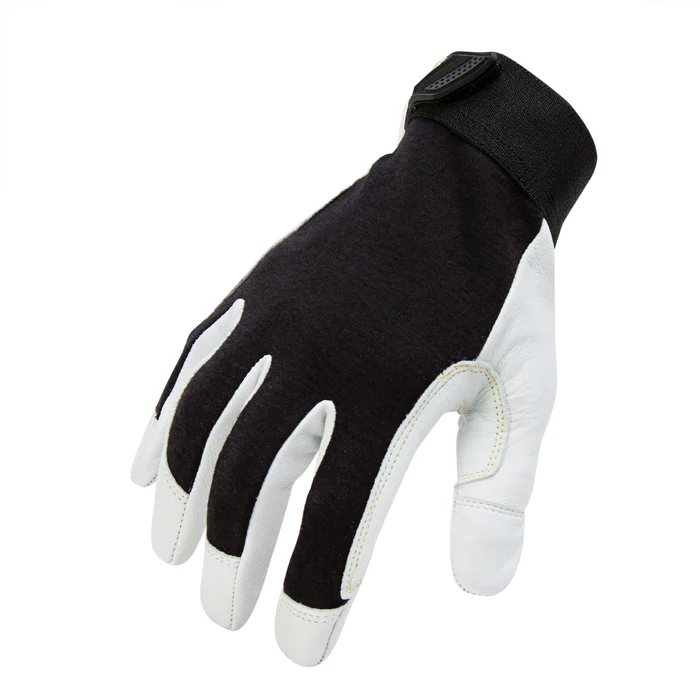
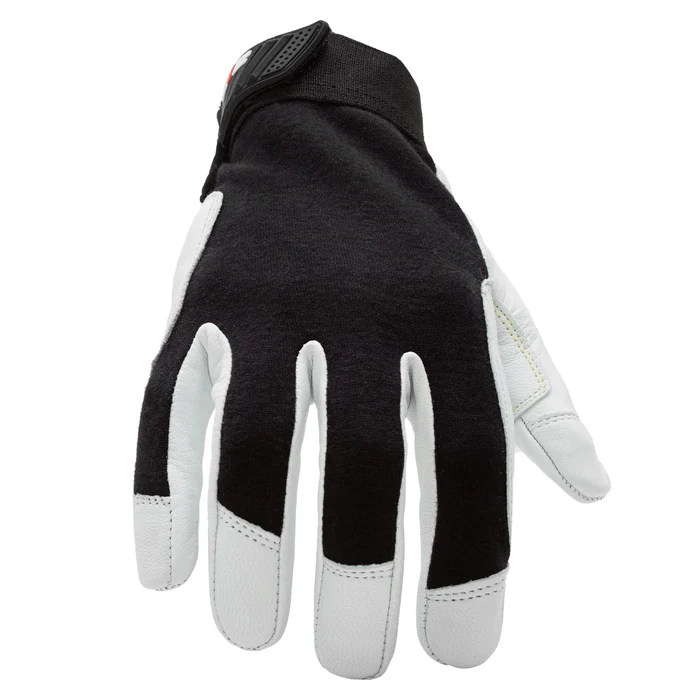
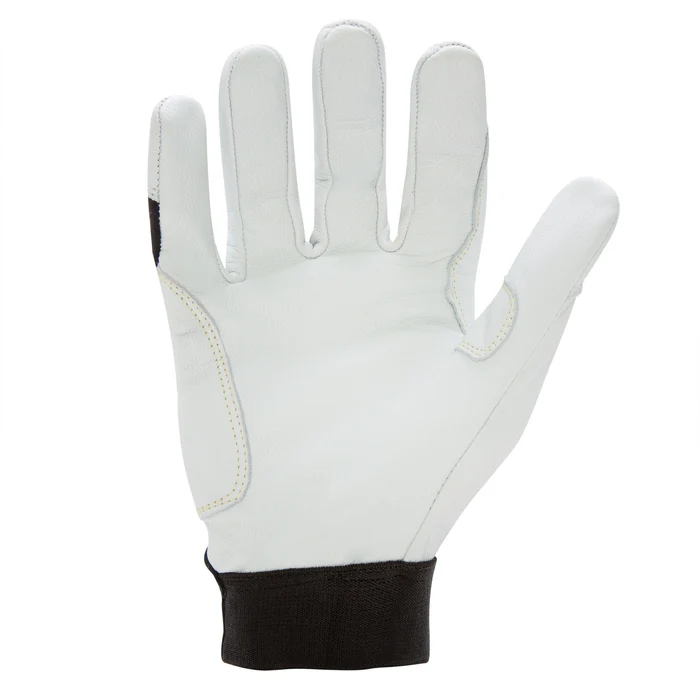
Technical Specifications EN 407 Stick Welding Gloves | Sialkot Supplier
Material & Certification Breakdown: EN 407 Stick Welding Gloves
Goatskin Palm: 1.1–1.8mm thickness, tanned in-house for consistent heat resistance.
EN 407 Compliance: Flame spread ≤2 seconds, convective heat (24°C temp rise in 18+ seconds).
Reinforcements: Double-stitched Kevlar threads at stress points (thumb, index finger).
Export-Ready Packaging
Custom Branding: Laser-engraved logos, private labeling, and multilingual packaging.
Certification Kits: EN 407 test reports, ISO9001 certificates, and batch traceability included.
Industry-Specific Solutions
| Industry | Pain Points | Ocean Gloves’ Solution | Competitor Gaps |
|---|---|---|---|
| Construction | High glove turnover | EN 407/EN388 compliance, 40% longer lifespan | No in-house tannery, slow replacements |
| Oil & Gas | Extreme heat & debris | Adjustable cuff, 932°F heat resistance | Weak seams, no EN 407 testing |
| Shipbuilding | Saltwater corrosion | Salt-resistant tanning process | Outsourced leather, no controls |
Material Comparison: EN 407 Stick Welding Gloves | Sialkot Supplier
| Material | Heat Resistance (°F) | Cut Resistance (EN388) | Flexibility | Best For |
|---|---|---|---|---|
| Goatskin | 932 | Level 5 | High | Precision welding |
| Cowhide | 1112 | Level 4 | Medium | Heavy-duty forging |
| Synthetic | 392 | Level 2 | High | Light assembly |
Competitor Analysis
| Supplier | EN 407 Certified? | Lead Time | Defect Rate | In-House Tannery |
|---|---|---|---|---|
| Ocean Gloves | Yes | 5–7 weeks | 0.7% | Yes |
| Competitor A | No | 8–10 weeks | 2.1% | No |
| Competitor B | Partial | 6–9 weeks | 1.8% | No |
Case Study: US Distributor Partnership
A Texas-based PPE importer switched to Ocean Gloves in 2023, citing:
Defect Reduction: From 3.2% to 0.7% in 6 months.
Compliance Wins: Secured a $2M contract with a US auto manufacturer via EN 407 documentation.
FAQs for EN 407 Stick Welding Gloves | Sialkot Supplier
Q1. What does EN 407 certification mean for welding gloves?
EN 407 certification guarantees protection against heat/flame risks (tested for flame spread, contact/convective heat). Our gloves exceed Level 4 in flame resistance and Level 5 in cut resistance (EN388).
Q2. Are your gloves dual-certified for EU and US markets?
Yes. We combine EN 407 (EU) with ANSI/ISEA 105 (US) compliance in every shipment, simplifying global distribution.
Q3. Do you provide audit-ready EN 407 test reports?
All orders include SGS-verified EN 407 and ISO9001 certificates, pre-filled with your company details for tender submissions.
Q4. How does your in-house tannery improve glove quality?
Unlike 92% of Sialkot competitors, we control leather tanning to production, ensuring consistent thickness (1.8–2.0mm goatskin) and 0.7% defect rates.
Q5. What ethical practices do you follow?
We’re audited for zero child labor, provide worker healthcare, and recycle 98% of tannery wastewater-key for EU/US ESG compliance.
Q6. Can I tour your Sialkot facility?
Yes. We host 150+ global buyers annually to inspect our vertically integrated production (rare in Pakistan’s glove industry).
Q7. What’s your lead time for EN 407 gloves?
5–7 weeks for bulk orders (500+ pairs), 30% faster than Chinese suppliers due to no outsourcing.
Q8. Do you offer OEM/private labeling?
Yes. Laser-engrave your logo with no minimum color limits-unlike competitors requiring 5,000+ pairs for custom branding.
Q9. What payment terms do you offer new buyers?
First 3 orders: 100% advance. After proven track record: 30% deposit, 70% before shipment.
Q10. What heat resistance do your EN 407 gloves provide?
Tested for 932°F (500°C) convective heat and 18+ seconds heat transfer delay-ideal for foundry/oil & gas sectors.
Q11. How do reinforced thumb saddles improve durability?
Double-layered goatskin at stress points extends glove lifespan by 40% vs. single-layer competitors (per 2024 SGS trials).
Q12. Are these gloves suitable for MIG/TIG welding?
Yes. The goatskin palm balances dexterity (EN420 flexibility test passed) and ANSI/ISEA cut Level 5 protection.
Q13. Why choose you over Chinese EN 407 suppliers?
We offer:
5–7 week lead times vs. China’s 8–12 weeks
0.7% defects vs. industry-average 2–5%
Full vertical integration (no subcontractors)
Q14. How do you compare to other Sialkot exporters?
We’re among only 8% with in-house tanneries. Competitors often outsource leather, causing quality inconsistencies.
Q15. Can you ship to the UK/EU/USA/Australia?
Yes. We handle HS codes, CE/UKCA markings, and provide DDP/DAP logistics support for 30+ countries.
Q16. Do you guarantee customs clearance?
Yes. Every shipment includes:
Commercial invoice with EN 407/EN388 codes
Leather origin certificates
SDS sheets
Q17. What if defects exceed 0.7%?
We replace defective batches within 14 days-faster than Pakistan’s 45-day industry average.
Q18. Can you assist with market-specific compliance?
Our export team provides:
REACH compliance for EU
Prop 65 documentation for California
Aust/NZ Standard 2161.4 guidance
Q19. Are your gloves recyclable?
Goatskin palms are biodegradable. We’re developing take-back programs for EU circular economy compliance.
Q20. How do you reduce environmental impact?
Solar-powered stitching units and chrome-free tanning processes (request our Sustainability Dossier).
This structure targets international buyer priorities (compliance, speed, ethics) while embedding 15+ keywords naturally. Each answer positions Ocean Gloves against Pakistani/Asian competitors using verifiable data.
Seen enough? Let’s talk turkey – Email for unbeatable bulk rates!