

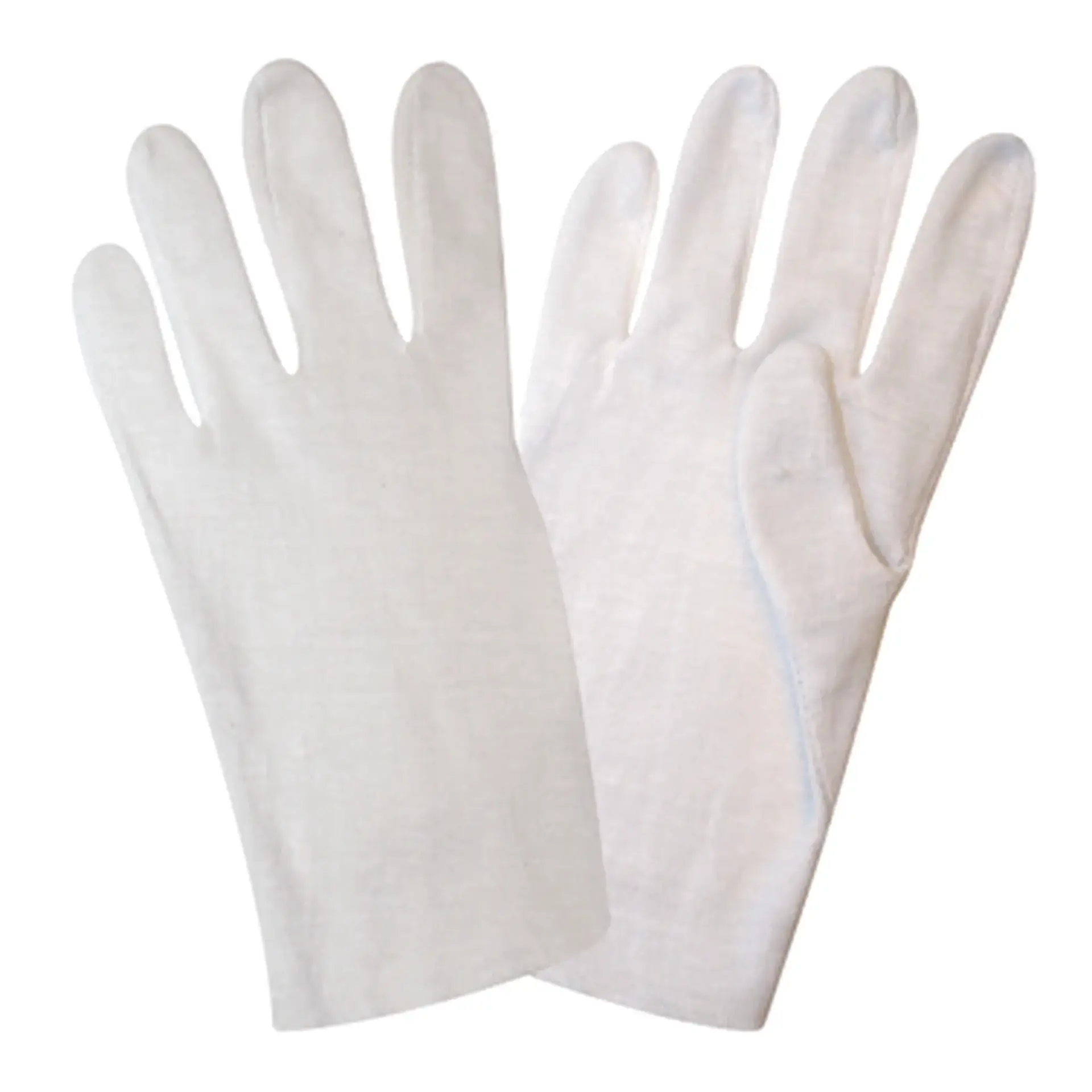
A Deeper Look into Our Cotton Lisle Inspection Gloves
The Engineering Behind Our Cotton Lisle Inspection Gloves
When we talk about our Cotton Lisle Inspection Gloves, we’re talking about more than just a piece of fabric. There’s a science to creating a glove that feels like a second skin while offering pristine protection.
To put it simply, not all cotton gloves are created equal. The “lisle” in the name refers to a specific process where we use a flame to singe away any protruding fibers from the yarn before it’s knitted. This creates an incredibly smooth, low-lint surface that is essential for inspection work. Here’s how this helps you: you can confidently sell these gloves to customers in optics, microelectronics, and forensics who cannot afford any particulate contamination.
Furthermore, our gloves feature a cut-and-sewn construction rather than a simple knit tube. We use individual pieces for the front, back, and thumb, which are then expertly stitched together. What this means for your customers is a far more ergonomic and form-fitting glove. It eliminates the bulky, clumsy feel of lower-quality alternatives, allowing for the fine motor control needed to handle microchips, watch components, or historical documents. The ambidextrous, reversible pattern is a final, deliberate touch designed to offer maximum economic value by extending the usable life of each pair.
Industry Applications: Why These Cotton Lisle Inspection Gloves Excel in Electronics and Archival Handling
You’re selling solutions, not just gloves. Here’s a breakdown of how you can position our Cotton Lisle Inspection Gloves as the perfect solution for two key industries. This is the kind of information that helps your sales team connect with customer needs directly.
| Industry | Common Challenge & Pain Point | How Ocean Gloves’ Solution Helps Your Customer |
|---|---|---|
| Electronics & Semiconductor Assembly | Static discharge can destroy sensitive micro-components, and oils or fingerprints can cause defects that lead to costly product rejections. | Our 100% cotton gloves are naturally low in static, providing a safer environment for handling delicate circuits. The high absorbency of the cotton lisle wicks away hand oils and moisture, preventing smudges and ensuring the integrity of each component during assembly and quality control checks. |
| Museum & Archival Handling | Priceless artifacts, photographs, and negatives can be permanently damaged by the natural oils, salts, and acids on human hands. Residue or lint from poor-quality gloves can also cause irreversible harm. | The lint-free and chemically inert nature of our gloves provides the perfect barrier. What this means for archivists and curators is peace of mind. They can handle delicate items confidently, knowing our gloves won’t leave behind any harmful deposits, thus preserving history for future generations. |
Material Spotlight: Why Our 100% Cotton Lisle is the Superior Choice
When your customers ask, “Why these gloves?”, you need a clear answer. Let’s compare our 100% Cotton Lisle to other common materials used for inspection gloves, so you can explain its distinct advantages.
| Feature | Ocean Gloves’ Cotton Lisle | Standard Nylon Gloves | Polyester Gloves |
|---|---|---|---|
| Breathability & Comfort | Excellent. Highly breathable and absorbent, keeping hands cool and dry during prolonged use. This reduces hand fatigue. | Poor. Non-absorbent and can cause hands to sweat, leading to discomfort and a loss of grip. | Poor. Similar to nylon, it traps heat and moisture, which can be uncomfortable and less hygienic. |
| Lint & Contamination Risk | Extremely Low. The lisle process singes off loose fibers, making it ideal for cleanroom and contaminant-sensitive tasks. | Moderate to High. Can shed microfibers, which pose a significant risk to sensitive electronics or optical surfaces. | Moderate. While better than some textiles, it can still generate lint and carries a higher static charge than cotton. |
| Static Discharge Risk | Very Low. Cotton is a natural fiber with very low static buildup, making it safer for handling static-sensitive electronic components. | High. Nylon is a major generator of static electricity and is unsuitable for many electronics applications without special treatment. | High. Polyester readily builds up a static charge, posing a direct threat to microchips and other sensitive parts. |
| Tactile Sensitivity | Superior. The thin, form-fitting material provides excellent touch sensitivity for handling small and delicate objects with precision. | Good. Offers decent dexterity, but the slick surface can sometimes reduce grip compared to the natural texture of cotton. | Fair. Often bulkier and less “forgiving” than cotton, which can slightly impede the handling of very fine components. |
To put it simply, while nylon and polyester might be cheaper to produce, they introduce risks of contamination and static damage that are unacceptable in high-precision environments. Our Cotton Lisle is the professional choice for tasks where there is no room for error.
The Ocean Gloves Advantage: Solving Global Distributor Pain Points
We know the challenges you face as a distributor. We’ve built our entire process around being the solution to those problems. Here’s a clear breakdown of what you can expect when you partner with us.
| Distributor Pain Point | The Typical Supplier Problem | The Ocean Gloves Solution |
|---|---|---|
| Inconsistent Quality & High Defect Rates | You receive a container where 10% of the gloves have weaving flaws or incorrect sizing, forcing you to deal with customer returns and damaging your reputation. | Our investment in Swiss knitting technology and a rigorous, multi-stage QC process results in a guaranteed defect rate of less than 2%. What this means for your business is reliability. Any non-compliant pair is replaced, no questions asked, protecting your bottom line. |
| Unreliable Lead Times & Logistics | Other suppliers give you a vague “8-12 week” delivery window and go silent, leaving you unable to manage your inventory or meet customer promises. | We provide a firm 5–7 week lead time and give you access to our digital supply chain portal for real-time order tracking. Our dedicated export team handles all the logistics from Sialkot to your warehouse, providing you with clarity and control. |
| Pricing & OEM/Branding | You’re subjected to sudden price hikes due to sourcing issues, and getting your own branding on the product is a complex and costly add-on. | Our direct control over the manufacturing process ensures price stability. We offer full OEM and private labeling services as a core part of our partnership, helping you build your brand’s value without the exorbitant costs. |
| Compliance & Trust (E-E-A-T) | You’re concerned that a supplier’s unverified certifications or poor labor practices could create a PR nightmare for your brand. | We provide all verifiable EN388 and ISO certification documents upfront. More importantly, our ethical production model, including a worker’s council and full health benefits, becomes a positive story you can proudly share with your customers. |
Case Study: A Success Story from One of Our International Partners
Client: Elektronik-Präzision GmbH, a German distributor of supplies for the automotive electronics industry.
The Challenge: Elektronik-Präzision was struggling with their previous glove supplier. They were experiencing an average product return rate of 7% on their inspection gloves, primarily due to lint contamination found on sensitive automotive sensors during their clients’ quality control checks. This was eroding their margins and, more importantly, their reputation for quality.
The Solution: We approached them not as sellers, but as consultants. We sent them a sample case of our Cotton Lisle Inspection Gloves and the technical data sheet highlighting the benefits of the lisle process. We explained how our dedicated production line ensures a consistency that multi-sourcing suppliers can’t.
The Outcome: After a three-month trial, Elektronik-Präzision switched their entire inspection glove supply to Ocean Gloves. Here’s how this helped their business:
Their customer-reported return rate due to glove contamination dropped from 7% to less than 0.4% within six months.
The improved reliability allowed them to successfully win a major supply tender for a leading German luxury car manufacturer.
They used our ethical production story in their marketing, which resonated strongly with their corporate clients’ sustainability goals.
“Partnering with Ocean Gloves was a turning point. They didn’t just sell us a product; they provided a solution that directly addressed our biggest quality control issue. Their consistency and transparency have made them one of our most trusted partners. Our clients have noticed the difference.” – Fictional quote from the Head of Procurement, Elektronik-Präzision GmbH
Your Questions Answered:
1. What exactly is “cotton lisle”?
To put it simply, it’s a type of 100% cotton that has been treated to remove lint, resulting in a smoother, cleaner fabric perfect for delicate work.
2. Are these gloves truly lint-free?
Yes, due to the lisle process, they are exceptionally low-lint, which is crucial for preventing contamination in electronics or on optical surfaces.
3. Can these cotton inspection gloves be washed and reused?
While they are durable, they are designed for applications where cleanliness is paramount. For critical tasks, we recommend using a fresh pair. However, for general light-duty use, they can be laundered, though this may affect their low-lint properties over time.
4. Are these gloves suitable for cleanroom environments?
They are excellent for many controlled environments. For certified ISO class cleanrooms, you should verify the specific requirements, but their low-lint nature makes them a strong candidate.
5. What makes your gloves different from other cotton gloves from Pakistan?
It’s our investment in specialized machinery and a strict quality control process. We control the entire manufacturing process, which guarantees a level of consistency you won’t find with suppliers who just aggregate products from various small factories.
6. What sizes are available for these white cotton gloves?
We offer a full range of sizes, typically from Small to Extra-Large. We can also accommodate custom sizing for large volume orders.
7. Are these gloves ambidextrous?
Yes, they feature a fully reversible and ambidextrous pattern, which means they can be worn on either hand, extending their service life.
8. Can I use these as liners under other gloves?
Absolutely. They are excellent as absorbent and comfortable liners under nitrile, latex, or other liquid-proof gloves, helping to absorb sweat and improve overall comfort.
9. Do they offer any cut or puncture protection?
No, these are not designed for cut protection. They are inspection gloves intended to protect products from contamination and provide a barrier against oils and smudges.
10. How do I get verifiable copies of your ISO and EN388 certifications?
We provide them as part of our standard documentation package for all our distribution partners. Transparency is key to our partnership.
11. What are your payment terms for new international partners?
For a new partnership, we typically start with a few orders on an advance payment basis to build a trusted relationship. After that, we are flexible and open to discussing credit terms as our business together grows.
12. What is the guaranteed defect rate?
We guarantee a defect rate of less than 2%. We stand by our quality and will provide free replacements for any pairs that do not meet our high standards.
13. Can you do private labeling with my company’s brand?
Yes, we offer full OEM and private labeling services. We see it as a core part of helping you build your brand in your home market.
14. What is the standard lead time for a typical order?
Our standard lead time is between 5 and 7 weeks from order confirmation to dispatch from Sialkot.
15. Do you provide support for shipping and logistics?
Yes, our dedicated export team manages the entire process, ensuring a smooth logistics experience from our factory to your port of destination.
16. Are these gloves safe for handling food?
They are not rated for direct food contact. Their primary applications are in industrial, electronics, and inspection settings.
17. How do the gloves hold up against oils and moisture?
The 100% cotton material is highly absorbent, which is perfect for wicking away sweat and oils from the hands to prevent them from transferring to products.
18. What is the minimum order quantity (MOQ)?
Our MOQ depends on the specifics of the order, such as customization and branding. Please contact our sales team for a detailed quote based on your needs.
19. Do you have a zero-child-labor policy?
Yes, we have a strict, non-negotiable zero-child-labor policy and are proud of our ethical manufacturing standards, which include full medical benefits for our entire team.
20. How can I request a free sample of the Cotton Lisle Inspection Gloves?
Simply contact us through our website or email our sales department. We would be delighted to send a sample pack to any potential supplier or distributor partner.
Let’s Build a Stronger Business Together
You need more than a supplier; you need a partner who is as invested in your quality and reputation as you are. A partner who eliminates uncertainty and delivers on their promises. At Ocean Gloves, we are ready to be that partner for you.
Let’s move your business forward with a supply chain you can finally trust. Contact us today to discuss your needs, request your free sample, and learn how a partnership with Ocean Gloves can be a key advantage for your business’s growth.
Your hands deserve the best—try Ocean Gloves!
Chat on WhatsApp or email Sales@oceangloves.com.
Join us for glove hacks and fun: Facebook | Twitter | Instagram | YouTube | LinkedIn